Turn Any Document into Quizzes, Flashcards, Mind Maps & Data Tables — Source-Grounded and Export-Ready
NotebookLM Studio goes far beyond summaries. Upload your sources and generate interactive quizzes, Anki-compatible flashcards, hierarchical mind maps, infographic-style guides, and structured data tables. Every output traces to your documents. Custom instructions control depth, format, and audience level.
NotebookLM’s Studio panel turns any document into five interactive, source-grounded outputs: quizzes, flashcards, mind maps, reports, and data tables. Each is generated directly from your uploaded sources with citations, with progress tracking on quizzes and flashcards and one-click export (data tables to Google Sheets).
TL;DR — Master all 5 NotebookLM interactive Studio tools in one guide. Generate quizzes, flashcards, mind maps, reports, and data tables from your documents. 1 free prompts — one per tool. Updated March 2026.
Updated June 2026. Maintained by a small team of AI super-users who teach multi-AI research and study workflows to researchers, students, and professionals — no affiliate relationships. About this guide →Changelog
For Educators
Upload course materials. Generate tiered quizzes, Anki flashcard decks, and visual mind maps — all source-grounded with correct answers cited.
For Students
Upload your reading list. Generate flashcards organized by topic difficulty. Each answer cites the specific page/passage. Export to Anki.
For Analysts
Data table extraction: define columns, NotebookLM fills rows from your sources at 94% accuracy. Export-ready for spreadsheets.
Need slide decks?
Slides are a separate Studio output. See the Pencil UI guide for generation + surgical revision workflows.
Go to Slide Pencil UI →Which Studio tool should you use?
| Tool | Best for | Output | Speed | Tier |
|---|---|---|---|---|
| Quiz | Testing retention, classroom assessments | Multiple-choice, short-answer, essay + answers | 30–60 sec | Free |
| Flashcards | Memorization, exam prep, onboarding | Q&A cards with citations, tiered difficulty | 20–30 sec | Free |
| Mind Map | Literature review, research scoping | Interactive visual concept diagram | 30 sec | Free |
| Reports | Briefings, study guides, FAQs, timelines | Structured text with citations | 30–60 sec | Free |
| Data Table | Action items, comparisons, structured extraction | Table → Google Sheets export | 30–60 sec | Pro/Ultra |
The Quiz feature turns passive reading into active testing. It generates multiple-choice, short-answer, and essay questions from your sources — each with fully cited answers that link back to the exact passage. This leverages the testing effect (retrieval practice), which cognitive science consistently shows outperforms re-reading for long-term retention.
Every wrong answer becomes a precise pointer to the material that needs review. For educators, it solves a time-consuming bottleneck: upload assigned readings, generate a quiz in 30 seconds, review and adjust, and a classroom assessment is ready. Because it’s source-grounded, questions test what’s actually in the readings — not generalized knowledge about the topic.
Best use cases
Post-reading self-testing — the highest-value use case. Read a paper, generate a quiz, and discover the gap between what you think you understood and what you can actually answer. Classroom assessments — generate quizzes at varying difficulty levels for knowledge checks, mid-unit review, or exam prep. Corporate training verification — confirm that team members absorbed training materials.
Limitations
Auto-generated questions occasionally focus on peripheral details rather than core concepts — always review before distributing. Essay rubrics are basic; create a separate scoring rubric for formal grading. Multiple-choice distractors are usually plausible but occasionally obvious.
Free prompt
Flashcards extracts key concepts, definitions, relationships, and facts from your sources and converts them into question-answer pairs. Unlike AI flashcards from ChatGPT (which might hallucinate), NotebookLM’s cards are grounded in your specific documents — each answer traces back to a citation. You’re studying what your sources actually say, not what an AI thinks the answer should be.
The educational science behind flashcards — active recall and spaced repetition — is among the most robustly supported learning strategies in cognitive psychology. The bottleneck has always been the time investment: creating quality flashcards manually takes hours. NotebookLM reduces that to seconds.
Best use cases
Exam preparation — the obvious case, from university finals to professional certifications (PMP, CFA, AWS, medical boards). Research retention — generate flashcards after reading a paper and review periodically to retain key findings months later. Employee onboarding — generate from company documentation, processes, and product specs.
Limitations
Most effective for factual and conceptual knowledge — less suited for procedural skills or creative application. Auto-generated cards sometimes focus on surface-level facts; use the chat to pre-filter important concepts before generating. Cards don’t export directly to Anki format — copy or use a third-party converter.
Free prompt
Mind Maps got a major upgrade in May 2026: prompt-controlled steering. The auto-generated structure of the old version is now one option among many — you can specify Tension Maps, Decision Architecture Maps, Literature Constellations, Content Ecosystem Maps, Second Brain Navigation Maps, and Meeting Synthesis Maps. The structural specification lives in your prompt; the model uses your sources to populate it.
The complete pattern library, free Tension-Map Generator prompt, scenarios, and competitive comparison vs. Whimsical AI / Miro AI / MarkMap / Notion AI all live on the dedicated authority page: → NotebookLM Mind Maps 2026: Prompt-Controlled Visual Thinking.
If you arrived looking for the old auto-generated mind map workflow — that still works, and is fastest for casual visualization. Use the free prompt below as a chat pre-analysis to prime the auto-generator. For research, decision, or content production work where the structure matters, follow the link above to the new authority page.
Free prompt (chat pre-analysis — for the legacy auto-generator)
Reports is the Swiss Army knife of the Studio panel. It generates structured text outputs — study guides, FAQ documents, timelines, briefing docs, and custom reports — all with citations linked to original sources. Unlike the chat (which answers individual questions), Reports produce complete formatted documents designed for a specific purpose.
The real power is in custom reports. By writing a detailed prompt, you can generate reports in virtually any format: SWOT analyses, literature review outlines, project status summaries, competitive analyses, risk assessments, or any other structured format your work requires. The AI follows your structural instructions while drawing exclusively from your uploaded sources.
Best use cases
Meeting preparation — upload relevant documents and generate a Briefing Doc with citations for when someone asks “where did that number come from?” Student study guides — upload course readings before finals. Knowledge management — generate a report before archiving a project notebook. Client deliverables — a well-structured report serves as a polished first draft. See also the Meeting Intelligence guide for meeting-specific workflows.
Limitations
Reports reflect only what’s in your sources — they won’t fill gaps with external knowledge. Long reports may repeat or lose coherence. Reports save as notebook notes, not formatted documents (PDF, Word) — copy content into your preferred tool.
Free prompt
Data Table is NotebookLM’s newest Studio feature (December 2025, alongside the Gemini 3 upgrade). It synthesizes source materials into clean, structured tables — extracting data points, organizing them into rows and columns, and making the result exportable to Google Sheets with one click. Turn meeting transcripts into action item trackers, research papers into comparison matrices, or competitive reports into feature grids.
The Google Sheets export is what makes this genuinely powerful in professional workflows. Generate a table, export to Sheets, and immediately have sortable, filterable, formula-ready data. A project manager can extract all action items from 10 meeting transcripts, sort by deadline, filter by owner, and have a complete project tracker in minutes.
Best use cases
Meeting management — the killer use case. Upload 5 meeting transcripts and generate a table of all action items with columns for owner, priority, deadline, and context. Research synthesis — upload 10 papers and generate a comparison table: author, year, methodology, sample size, key finding, limitation. Competitive intelligence — upload competitor reports and generate a comparison of features, pricing, positioning, and strengths.
Limitations
Data Table requires Google AI Pro or Ultra — it’s not on the free tier. The AI decides columns unless you specify in the prompt, so always write explicit column instructions. Very large tables (100+ rows) may have inconsistencies. Spot-check a sample against original sources. Works best with sources containing clearly structured information; narrative or opinion-based sources produce less useful tables.
Free prompt
Quiz + Flashcards + Mind Map + Reports — 4 active recall formats that lock knowledge into long-term memory
- Active recall beats passive review 3:1. Quizzes and flashcards force retrieval, which is the single most effective study technique according to learning science.
- Mind maps reveal structure invisible in text. Concept relationships, hierarchies, and gaps become immediately visible — what takes 2 hours of reading takes 10 seconds to scan.
- Auto-generated, source-grounded. Every quiz question, every flashcard answer, every mind map node traces back to your uploaded documents — not AI confabulation.
Complete interactive tool library below ↓
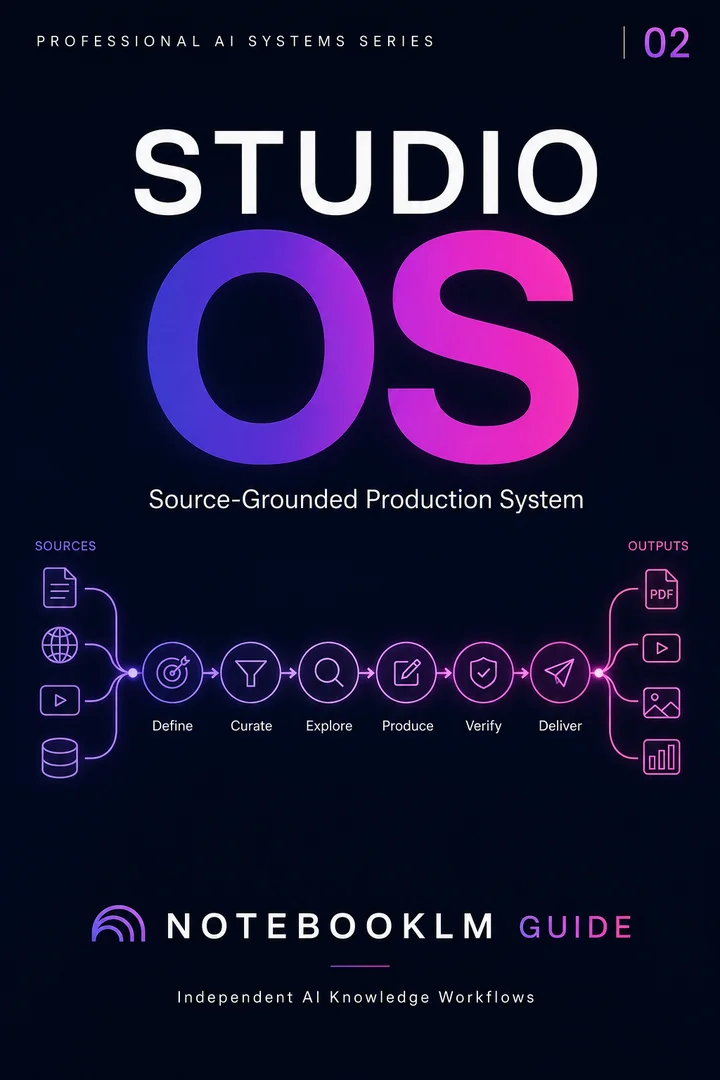
Unlock the Full Prompt Collection
Cross-source synthesis, multimodal extraction, slide optimization, Studio customization, troubleshooting diagnostics, and advanced multi-AI workflows — for researchers, business professionals, and educators.
Category Bundle — one-time access
Explore the Studio Prompt PackageFrequently asked questions
30 copy-ready AI prompts · one PDF
Thirty prompts you can paste today, sorted across research, content, Studio outputs and multi-AI work. Instant access. No credit card.