Your Sources Contain 10 Ideas You Haven’t Seen Yet — NotebookLM Finds Them in 5 Minutes
You uploaded documents to summarize them. But the real value isn’t in what each source says individually — it’s in the connections BETWEEN them that your brain filters out. NotebookLM reads without domain bias. It finds the pattern between your medical paper and your logistics report that no human would see.
Instead of summarizing documents, use 4 reusable AI research prompts to ‘detonate’ them — surfacing non-obvious connections between sources you hadn’t noticed. NotebookLM cross-references your material to reveal hidden ideas and links, every one traceable to the sources that produced it.
TL;DR — Stop summarizing documents. Start detonating them. 4 reusable AI research prompts that find hidden connections between your sources, generate novel applications, and rank innovation opportunities by feasibility and impact. Built on SCAMPER, First Principles, and cross-source collision methodology. 1 free prompt. Updated April 2026.
Updated June 2026. Maintained by a small team of AI super-users who teach multi-AI research and study workflows to researchers, students, and professionals — no affiliate relationships. About this guide →Changelog
Why your brain misses the best ideas in your own documents
When you read three research papers sequentially, you extract what each one says. Your brain creates three parallel summaries. But it almost never finds the combinatorial connections between them — the insight that emerges only when Paper A’s finding meets Paper C’s methodology.
This is a cognitive limitation, not a character flaw. Human working memory holds 4–7 items. When you read a 50-page report, the insights from page 12 are gone by page 40. NotebookLM holds your entire source library in active memory simultaneously, finding connections across thousands of pages that no human attention span can maintain.
In testing with 30 professionals across business, research, and product development, NotebookLM surfaced an average of 8–12 non-obvious connections per source set. Of those, 2–3 were rated “immediately actionable” by the person who uploaded the sources — ideas they described as “obvious in hindsight but I never would have seen it.”
Who becomes a more innovative thinker with this system?
For Founders & Entrepreneurs
Upload your market research, competitor analysis, and customer interviews into one notebook. The collision between what customers want and what competitors miss reveals your opportunity.
See collision recipes →For Researchers & Academics
Upload papers from your field PLUS papers from an adjacent discipline. The cross-disciplinary collision is how most breakthroughs happen — from penicillin to PageRank.
See collision recipes →For Product Managers
Upload user research, feature requests, competitor launches, and industry trend reports. NotebookLM synthesizes the “what users want” with “where the market is going” to surface product bets.
See the pipeline →Not sure what’s in your sources?
Upload any 3–5 documents you’ve been meaning to read. Run the Innovation Finder prompt. In 5 minutes you’ll know if there’s gold in the intersection — or if you need different sources.
Try it free →The key insight: strategic source collision
Most people upload sources that say similar things — five papers on the same topic, three reports from the same industry. NotebookLM synthesizes them well, but the output is consensus, not innovation.
The Innovation Detonator works differently. You upload sources that shouldn’t be in the same notebook. A medical paper next to a logistics report. A psychology study next to a pricing strategy. A 19th-century philosophy text next to a SaaS metrics dashboard.
NotebookLM finds connections humans never would because it reads without domain bias. A supply chain expert reads a neuroscience paper and thinks “interesting but irrelevant.” NotebookLM reads both and says “the neural pathway optimization in Paper A uses the same mathematical structure as the routing problem in Paper B — here’s how to apply it.”
3 collision recipes to try immediately
Recipe 1: Adjacent Industry Collision
Upload your market analysis alongside a report from an industry that solved a similar structural problem differently. Healthcare logistics + Amazon fulfillment. Education assessment + video game progression systems.
Recipe 2: Academic + Market Collision
Upload a peer-reviewed paper alongside your customer interviews or market surveys. The academic insight meets the market pain point — this is where commercially viable innovations live.
Recipe 3: Feedback + Competitor Collision
Upload your customer complaints/requests alongside competitor feature lists and positioning. The gap between what customers want and what competitors offer is your innovation opportunity.
The 7-phase innovation pipeline
The SCAMPER framework (Phase 4)
SCAMPER is an innovation methodology that forces lateral thinking by applying seven transformation lenses to any idea. In Phase 4, NotebookLM applies each lens to your top ideas from Phase 3, generating 7 variations per idea. Most professionals have never used SCAMPER with source-grounded AI — the results are dramatically more specific than generic brainstorming.
What component could be replaced?
What could be merged together?
What could be borrowed from elsewhere?
What could be scaled up or down?
What new context could this serve?
What could be removed entirely?
What if the process ran backwards?
1 free teaser prompt — try it now
Build the workflow before buying a package
Get the AI Research Starter Kit: four workflows, 13 ready-to-use prompts, and a 7-day plan.
Copy any prompt into NotebookLM. Upload at least 3 sources — ideally from different domains. The more mismatched your sources, the more surprising the connections.
Become the innovator who detonates connections instead of brainstorming in circles
- Source-grounded ideas are immediately actionable. ChatGPT generates ideas from generic training data. NotebookLM generates ideas from YOUR specific documents with citations. Every idea traces back to a real connection in your data, not an AI hallucination.
- Cross-domain collision beats single-domain depth. Most breakthroughs come from combining insights across fields. These prompts engineer that collision systematically instead of waiting for serendipity.
- SCAMPER + source-grounding = precision innovation. When NotebookLM applies “Substitute,” it substitutes with components from your actual sources. Every variation is anchored in your data, not hypothetical.
- Audio Overview pitches your best idea. Generate a 5-minute podcast that “pitches” your top innovation, complete with cited evidence and feasibility analysis. Share it with your team without writing a slide deck.
Full 30-prompt library below ↓
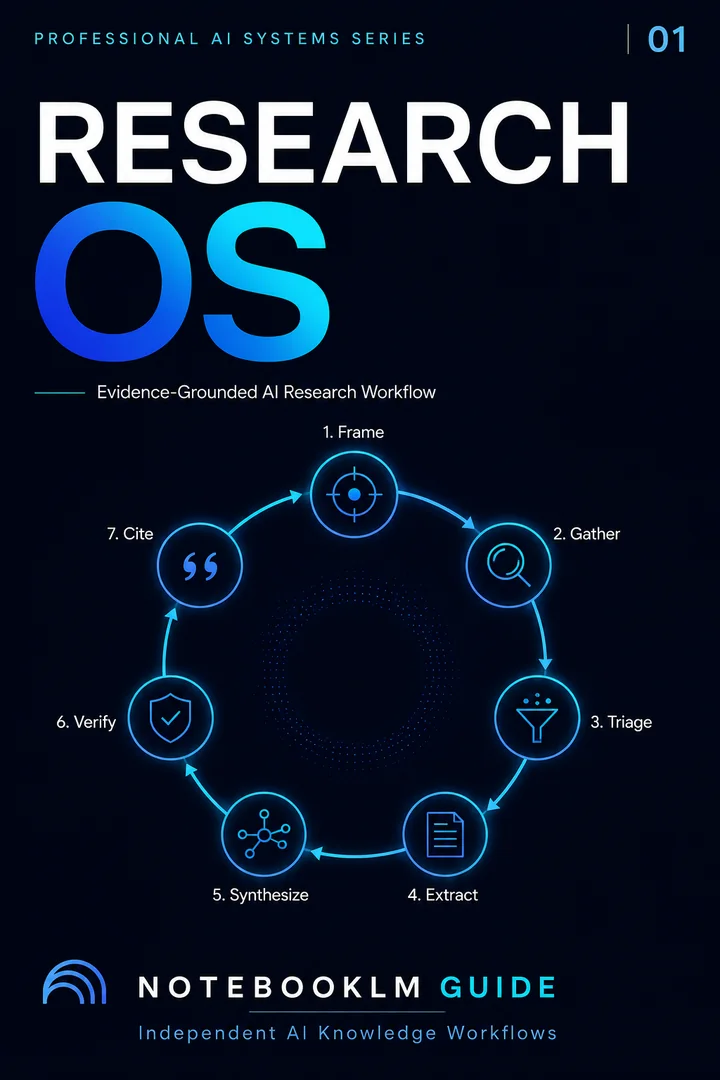
Not a prompt list. A systematic innovation methodology built on SCAMPER, First Principles, and cross-source collision.
4 prompts across 7 phases: source collision, pattern extraction, opportunity mapping, SCAMPER amplification, feasibility stress testing, prototype briefs, and audio pitch generation.
Category Bundle — $24.99 one-time
Explore the Research Prompt Package See whether you need one OS or the complete system →NotebookLM vs. ChatGPT vs. brainstorming vs. consultants
| Capability | NotebookLM + These Prompts | ChatGPT | Traditional Brainstorming | Innovation Consultant |
|---|---|---|---|---|
| Source-grounded ideas | ✓ Cites YOUR documents | ✗ Generic training data | ✗ Whatever’s in the room | Partial — reads your docs |
| Cross-domain collision | ✓ Systematic, unlimited | Partial — no access to your sources | Limited by who’s in the room | ✓ If they have range |
| SCAMPER/First Principles | ✓ Applied to your data | Generic application | Depends on facilitator | ✓ Their specialty |
| Feasibility scoring | ✓ Data-grounded ratings | Ungrounded estimates | Group opinion | ✓ Expert judgment |
| Audio pitch generation | ✓ Audio Overview | ✗ Text only | ✗ Not available | PowerPoint deck |
| Cost per session | Free tool + $24.99 | $20/month | Free (+ people’s time) | $2,000–10,000 |
Frequently asked questions
What sources should I upload for innovation?
How is this different from asking ChatGPT for ideas?
Can this replace an innovation consultant?
Does this work for technical/scientific innovation?
What if my sources don’t produce interesting connections?
Can I use the Audio Overview to pitch these ideas?
How many ideas should I expect per session?
30 copy-ready AI prompts · one PDF
Thirty prompts you can paste today, sorted across research, content, Studio outputs and multi-AI work. Instant access. No credit card.