AP Lang Multi-Agent Study System — 4 AI Engines, 100 Prompts, 7 Phases
A structured study system for the AP English Language exam using four AI tools working together. NotebookLM analyzes your rubric and practice essays with source-grounded citations. Claude scaffolds essays and diagnoses rubric-row weaknesses. Gemini maps argument structures visually. ChatGPT generates MCQ passage drills. 100 prompts organized into a 7-phase pipeline with a PPAE loop (Perceive, Plan, Act, Evaluate).
The 4 agents and their roles
Holds your College Board rubrics, scored practice essays, and passage collections. Responses cite your uploaded rubric language. Does not generate generic writing advice — every analysis is grounded in your specific sources.
Scaffolds all 3 essay types: rhetorical analysis, argument, and synthesis. Builds the identify → explain effect → connect to purpose chain. Scores practice essays against the rubric with specific revision targets.
Creates visual argument maps, rhetorical strategy flowcharts, and synthesis source-integration diagrams. Can process passage images and annotations for visual analysis.
Generates MCQ passage drills, rhetorical device flashcard decks, and quick style checks. Can format essay responses and produce practice questions at volume.
Row A earns 0–1 points. Row B earns 0–4 points. The rubric structurally rewards effect explanation over device identification.
The AP Lang rubric's point allocation means that identifying which strategies an author uses is necessary but insufficient. The majority of scoring differentiation happens in Row B, where the essay must explain the specific effect of each strategy on the audience. This system's core function is to shift practice time from identification (which NotebookLM can do quickly) to effect explanation (where student practice has the most scoring impact).
The Perceive → Plan → Act → Evaluate loop
How the PPAE loop works for AP Lang
Perceive: Upload your scored practice essays and the College Board rubric to NotebookLM. Ask: “For each essay, identify which rubric rows I earned and which I missed. Show specific evidence from my writing.” This produces a diagnostic map of your analytical gaps.
Plan: Copy that diagnostic into Claude. Ask: “Design a 3-week essay improvement plan targeting my weakest rubric rows. For each practice session, specify which essay type to practice and which analytical skill to focus on.”
Act: Each session uses the engine suited to the task. NotebookLM for rubric-grounded analysis. Claude for building the effect-explanation chain. Gemini for mapping argument structures visually. ChatGPT for MCQ passage drills.
Evaluate: After each timed essay, paste your response into Claude with the rubric. Ask: “Score this essay against the AP rubric. For each point I missed, explain what I should have written and why.” Then loop back to the weakest area.
The most common AP Lang essay pattern: naming devices without analyzing effects
The pattern this system is designed to address is consistent across student essays: students identify rhetorical strategies (ethos, pathos, logos, imagery, diction, syntax) but do not explain why those strategies work in the specific context of the passage. This is a Row A skill that earns at most 1 point.
The rubric allocates significantly more points to Row B, which requires explaining the effect of each strategy on the audience and connecting it to the author's purpose. The shift from identification to analysis is the central skill this system trains.
Row A vs. Row B: Sentence-Level Comparison
“The author uses pathos to appeal to the reader's emotions.”
“The author deploys visceral imagery of the factory floor in order to evoke guilt in the suburban reader, thereby making the argument for regulation feel personal rather than abstract.”
The Three-Move Chain: Body Paragraph Level
“The author uses diction and imagery throughout the passage. For example, she uses words like ‘devastating’ and ‘relentless.’ This helps the reader understand the problem. The author also uses statistics to support her argument.”
“The author's diction — words like ‘devastating’ and ‘relentless’ — frames the crisis as an active, ongoing force rather than a static condition. This word choice evokes urgency in the reader, positioning inaction as a form of complicity. By pairing this emotionally charged language with specific data points later in the paragraph, the author ensures that the reader's emotional response is anchored to empirical evidence, making the call to regulation feel both morally necessary and factually grounded.”
The 7-phase AP Lang mastery system
Build Your Rubric Analysis Vault in NotebookLM
- Upload College Board AP Lang rubrics (all rows for each essay type) into a NotebookLM notebook.
- Upload your scored practice essays — include both high-scoring and low-scoring examples so NotebookLM can compare them.
- Ask NotebookLM: “For each of my practice essays, map which rubric rows I earned. Show the specific sentences from my essay that earned each point, and identify what was missing from rows I didn’t earn.”
- Ask NotebookLM: “Compare my weakest and strongest essays side-by-side. What specific analytical moves are present in one but absent from the other?”
Train the Identify-Effect-Purpose Chain
- In NotebookLM: “From my uploaded passage collection, select 5 passages with different rhetorical approaches. For each, identify the 3 most prominent rhetorical strategies.”
- In NotebookLM: For each strategy, ask: “Write a WEAK analysis sentence that only identifies the device, and a STRONG analysis sentence that explains the effect on the audience and connects to the author's purpose. Explain what makes the strong version score higher on the rubric.”
- Hand off to Claude: Take the 5 strong analysis sentences and ask: “For each sentence, expand it into a full body paragraph with a topic sentence, textual evidence, and a closing analysis sentence that connects to the author's broader purpose.”
- Practice the template: “The author employs [strategy] in order to [effect verb] the audience's [response], thereby [advancing/undermining/complicating] the argument that [claim].”
Build Essay Templates for Rhetorical Analysis, Argument, and Synthesis
- Rhetorical Analysis scaffold (Claude): “Build a 5-paragraph rhetorical analysis essay outline for this passage. Each body paragraph must follow: identify strategy → explain effect on audience → connect to author’s purpose. Cite rubric rows for each move.”
- Argument scaffold (Claude): “Build an argument essay outline for this prompt. Include: defensible thesis, 3 supporting claims with evidence, one counter-argument with rebuttal. Each body paragraph must include a claim, evidence, and commentary explaining why the evidence supports the claim.”
- Synthesis scaffold (Claude): “Build a synthesis essay outline using these sources. For each body paragraph, specify which sources to cite, how to integrate them (direct quote, paraphrase, or summary), and how each source supports the paragraph’s claim.”
- Visual structure map (Gemini): “Create a visual argument map showing how the author builds their case: thesis, supporting strategies, audience shifts, and conclusion. Show the rhetorical progression.”
- Rubric grounding (NotebookLM): “From my uploaded rubric, show me exactly which rubric row each section of this essay scaffold is designed to earn.”
Build MCQ Passage Analysis Skills with ChatGPT
- Generate practice questions (ChatGPT): “Generate 10 AP Lang MCQ questions based on this passage. Include questions testing rhetorical purpose, audience awareness, and stylistic effect. For each question, provide 4 answer choices and explain why the correct answer is correct and why each distractor is wrong.”
- Generate flashcards (ChatGPT): “Create a set of 20 rhetorical device flashcards. Each card: device name, one-sentence definition, example of how it functions in argumentative writing.”
- Error analysis: After completing a set, categorize errors: reading comprehension (misunderstood passage), rhetorical vocabulary (didn't know the term), or purpose analysis (misidentified why the author made a choice).
- Targeted practice: Based on your error categories, ask ChatGPT to generate additional questions focused on your weakest area.
Practice Under Exam Conditions
- Set a 40-minute timer. Choose one essay type (rotate through all three across sessions).
- Write the essay using the scaffold from Phase 3 as reference. The goal is to internalize the three-move chain without relying on the scaffold.
- Paste your essay into Claude with this prompt: “Score my AP Lang essay using the College Board rubric. For each row (A, B, C): (1) state how many points I earned, (2) quote the specific sentence from my essay that earned or missed each point, (3) for missed points, write the specific sentence I should have written instead.”
- If Row B points were missed: Return to Phase 2 (Rhetoric) and practice the effect-explanation chain.
- If Row C points were missed: Proceed to Phase 6 (Sophistication).
Build the Analytical Nuance That Earns Row C
- Generate alternative interpretations (Claude): “For this passage, identify 2 alternative or competing interpretations of the author's rhetorical strategy in paragraph 3. For each, explain the evidence that supports it and the evidence that complicates it.”
- Ground in source text (NotebookLM): “From my uploaded passage, quote the specific lines that could support each of these alternative interpretations. Explain which interpretation the textual evidence most strongly supports.”
- Practice counter-argument integration (Claude): “Write a body paragraph that acknowledges an alternative interpretation of the author's use of [strategy], then explains why the primary interpretation is stronger based on textual evidence. This paragraph should model the sophistication point move.”
- Contextual significance (Claude): “Explain the significance of the author's rhetorical choices within the broader context of the genre, historical moment, or public discourse. How does understanding this context deepen the analysis?”
Consolidate Skills in the Final 48 Hours
- Rubric review (NotebookLM): “Summarize the key rubric requirements for all 3 essay types. For each row (A, B, C), list the single most important thing I must do to earn that point.”
- Template review (Claude): “Give me my 3 essay templates (rhetorical analysis, argument, synthesis) in the most condensed form — one paragraph each that I can memorize as a structural reference.”
- MCQ warm-up (ChatGPT): Complete one set of 10 MCQ questions. Focus on maintaining speed and accuracy, not learning new question types.
- One timed essay: Write one final timed essay (any type). Score it with Claude. Do not attempt to learn new skills — focus on executing the three-move chain consistently.
Each paragraph in a high-scoring AP Lang essay completes three moves: identify the strategy, explain its effect on the audience, and connect it to the author's purpose.
AP Lang rewards analytical precision. The students scoring 5s analyze more deeply per paragraph rather than covering more devices. Each body paragraph does three specific things: identify the strategy, explain its effect on the audience, and connect that effect to the author's broader purpose. The multi-agent workflow trains this three-move chain until it becomes the default analytical pattern.
3 free prompts — try them now
These three prompts correspond to the PPAE loop: Perceive (diagnosis), Act (effect-analysis training), and Evaluate (essay scoring). Upload your AP Lang rubrics and practice essays to NotebookLM before using Prompt 1. Use Prompt 2 in NotebookLM, then hand off outputs to Claude. Use Prompt 3 directly in Claude.
Study timeline by baseline score
The timeline below is based on the estimates provided in this content. Individual results will vary based on baseline writing skill, consistency of practice, and the quality of uploaded source materials. The PPAE loop is designed to be repeated — each iteration targets a different weakness.
Diagnosis and Row B targeting
Complete Phase 1 (Diagnose) to identify which rubric rows you are missing. Run Phase 2 (Rhetoric) sessions focusing on the effect-explanation chain. Complete Phase 4 (MCQ) drills to build passage analysis speed. Use the PPAE loop to cycle through these phases. Target: consistent Row B points.
Essay scaffolding and timed practice
Complete Phase 3 (Essays) for all three essay types. Begin Phase 5 (Simulate) with timed essay drills. Use Claude to score each essay and identify remaining rubric gaps. Cycle back to Phase 2 or 3 for persistent weaknesses.
Sophistication targeting (Row C)
Complete Phase 6 (Sophistication). Practice counter-argument integration and alternative interpretations with Claude. Ground analyses in source text with NotebookLM. Continue timed essay practice from Phase 5. Target: earning the Row C sophistication point consistently.
Sprint and consolidate
Complete Phase 7 (Sprint). Review rubric summaries in NotebookLM. Memorize condensed essay templates from Claude. Complete one MCQ drill set and one timed essay. Focus on executing what you have practiced, not learning new material.
The estimated total is 15–25 hours across 3–5 weeks, with sessions of 40–60 minutes each, 3–5 times per week. The PPAE loop is the structural backbone: each iteration should target a different rubric-row weakness based on your most recent essay scores.
MCQ practice with the multi-agent system
The AP Lang multiple-choice section tests passage-based analysis: identifying rhetorical purpose, evaluating the effect of stylistic choices, and understanding how arguments function in context. ChatGPT is the primary engine for MCQ practice within this system.
Recommended MCQ workflow
Step 1: Upload or paste a passage into ChatGPT. Prompt: “Generate 10 AP Lang MCQ questions based on this passage. Include questions testing rhetorical purpose, audience awareness, and stylistic effect. For each question, provide 4 answer choices and explain why the correct answer is correct and why each distractor is wrong.”
Step 2: Complete the questions. For each incorrect answer, categorize the error type:
- Comprehension: You misunderstood what the passage said.
- Vocabulary: You did not know the rhetorical term or concept.
- Purpose: You misidentified why the author made a specific choice.
Step 3: Ask ChatGPT to generate additional questions focused on your most common error type. For vocabulary errors, ask for flashcard decks. For purpose errors, ask for questions that specifically test “why did the author do X?”
Step 4: Track your accuracy across sessions. The goal is not just to complete questions but to reduce the error rate in your weakest category over time.
Synthesis essay: source integration workflow
The synthesis essay is the most structurally distinct of the three AP Lang essay types. It requires integrating multiple provided sources into an original argument, rather than analyzing a single passage or constructing a free-standing argument from personal knowledge. The multi-agent workflow for synthesis targets the specific skills this essay demands: source selection, integration, and citation.
Source analysis (NotebookLM)
Upload the source packet to NotebookLM. Ask: “For each source, identify: (1) the source type (text excerpt, data, visual, primary document), (2) the key claim or finding, (3) which position on the prompt question it supports or complicates, (4) one direct quote that would be most effective in an essay.”
Source integration map (Gemini)
Ask Gemini: “Create a visual map showing which sources can be grouped together in the same body paragraph, where sources conflict, and which sources provide the strongest evidence for each position.”
Essay scaffold (Claude)
Ask Claude: “Build a synthesis essay outline. For each body paragraph, specify: which sources to cite, whether to use direct quote, paraphrase, or summary for each, and how to connect the sources to the paragraph's claim. Each body paragraph must cite at least 2 sources.”
Source citation practice (Claude)
Ask Claude: “Show me 3 ways to integrate this source into a body paragraph: (1) as a direct quote with commentary, (2) as a paraphrase with commentary, (3) as a summary reference. For each, explain how the integration supports the paragraph's claim.”
Multi-agent AI vs. single AI vs. solo study
| Capability | Multi-Agent (4 Engines) | Single AI (e.g., ChatGPT) | Solo Study |
|---|---|---|---|
| Rubric-grounded analysis | ✓ NotebookLM cites YOUR rubric | Generic rubric references | ✓ Requires teacher feedback |
| Effect-explanation training | ✓ Claude builds weak-vs-strong chains | Can explain the concept | Self-diagnosis is slow |
| Argument structure maps | ✓ Gemini creates visual outlines | Text output only | Hand-drawn only |
| All 3 essay type scaffolds | ✓ Claude scaffolds each type | Can scaffold one at a time | Depends on teacher |
| MCQ drill generation | ✓ ChatGPT at volume | ✓ Same capability | Limited to released exams |
| Source-grounded responses | ✓ NotebookLM constrains to your sources | May generate unsourced claims | N/A |
| Cost | NotebookLM: free. Prompt library: $24.99 one-time. Claude/Gemini/ChatGPT: free tiers. | Free tier or $20/month premium | Free, higher time investment |
4 AI engines, 100 prompts, 7 phases, 1 PPAE loop
- Source-grounded analysis. NotebookLM constrains responses to your uploaded rubrics and essays. Every analysis cites your specific materials rather than generating generic advice.
- Row-specific targeting. The PPAE loop diagnoses which rubric rows you are missing and directs practice toward them. Row B (effect explanation) is the primary target; Row C (sophistication) is the advanced target.
- Multi-agent handoff. Prompts are designed to produce outputs that transfer between engines. NotebookLM diagnostics feed Claude's essay plans. Claude's templates feed ChatGPT's practice drills.
- Visual structure support. Gemini creates argument maps and source-integration diagrams that provide a reference during timed practice, reducing planning time within the 40-minute window.
- Iterative improvement. The PPAE loop is designed to be repeated. Each pass targets a finer rubric-row weakness. The system scales from diagnosis (Phase 1) through sophistication (Phase 6) to exam-day consolidation (Phase 7).
Premium prompt library below
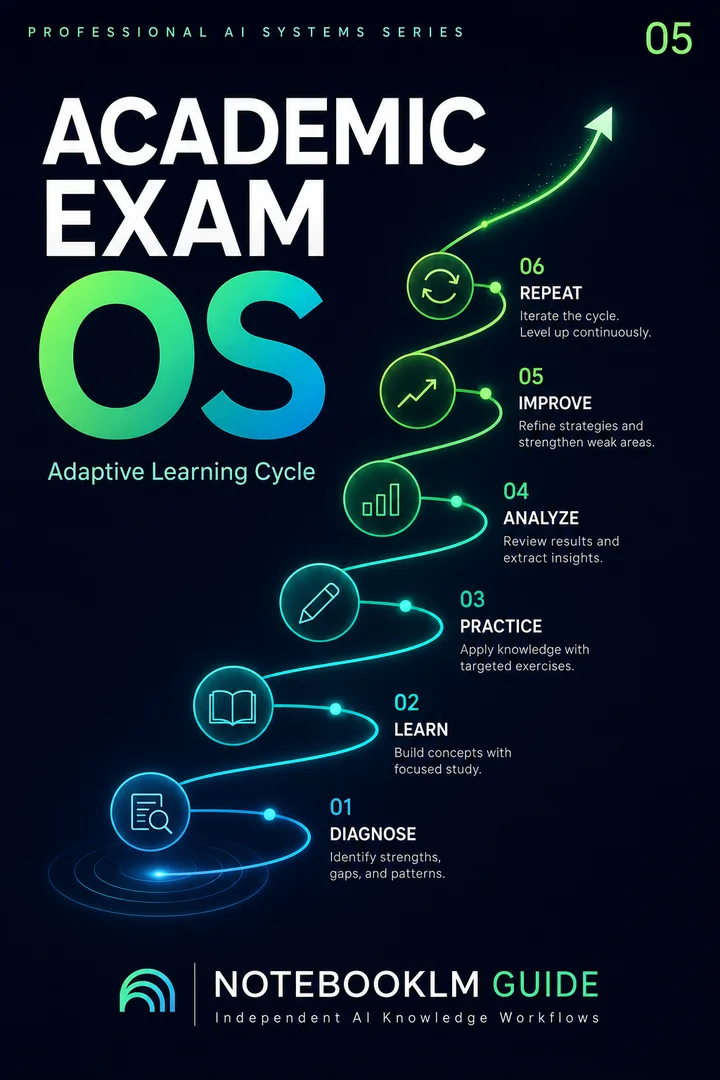
Unlock the full multi-agent prompt library for AP English Language study.
70 universal workflow prompts (the 7-phase PPAE system, applicable across subjects) + 27 AP Lang-specific prompts covering rhetorical analysis templates, argument evidence banking, synthesis source-weaving, and sophistication point targeting. Each prompt includes multi-agent handoff instructions.
Get Academic Exam OS — $24.99
Get Academic Exam OS — $24.99 Sovereign OS — $69.99 · 600+ pagesA 7-phase analytical precision system that trains the effect-explanation skill the rubric rewards.
70 universal prompts organized into 7 phases (Diagnose, Rhetoric, Essays, MCQ, Simulate, Score 5, Sprint) + AP Lang blocks for all 3 essay types + multi-agent handoff instructions for NotebookLM, Claude, Gemini, and ChatGPT.
One-time access
Get Academic Exam OS — $24.99 Sovereign OS — $69.99 · 600+ pagesFrequently asked questions
What does the AP Lang exam consist of?
Can I use just NotebookLM without the other 3 AI tools?
What sources should I upload to NotebookLM?
How long does it take to see improvement?
Is NotebookLM free?
What is the difference between AP Lang and AP Literature?
Will this help with the synthesis essay specifically?
How are the 100 prompts organized?
Can it generate slide decks for review?
More AP and exam prep
Guides from the same topic cluster.
AP English Literature
Poetry and prose literary analysis with multi-agent workflow
ExamAP Biology
Cross-unit concept connections and FRQ scaffolding
ExamAP Psychology
Apply theories to scenarios with AI-guided practice
ExamAP US History
DBQ and LEQ scaffolding with NotebookLM
ExamSAT 1500+
Source-grounded AI tutoring for the digital SAT