Score 1500+ on the Digital SAT — Your $0 AI Tutor That Outperforms the $150/hr One
You’re grinding through practice tests, but your score plateaus because you’re practicing problems without extracting patterns. Meanwhile, the students who jump 200+ points are using AI to reverse-engineer College Board question design, build vocabulary in context, and generate adaptive math drills — all grounded in their own prep materials.
TL;DR — This guide is a 7-phase system of 100 NotebookLM prompts for Digital SAT prep. It turns practice tests into a diagnostic tutor by extracting patterns from your mistakes, with one free teaser prompt on the page and a comparison with ChatGPT, Khan Academy and a private tutor. It is independent and does not promise a score.
Page last updated May 23, 2026. Independent guide by NotebookLM Guide; no affiliation with Google.
Who becomes a higher-scoring test-taker with this system?
For Juniors & Seniors
4–8 weeks from test day. You’ve taken practice tests but your score isn’t rising because you’re not extracting patterns. Phase 2–3 build the pattern recognition that turns practice into points.
Start at Phase 1 →For SAT Retakers
Scored below target. The Error Pattern Profiler diagnoses exactly where your reasoning breaks — content gap, trap pattern, or time management — then generates targeted drills.
Start at Phase 5 →For Self-Studiers & First-Gen Students
Can’t afford Princeton Review or a private tutor? NotebookLM is free. These prompts turn it into a personalized study system built from your own materials. Same patterns, zero cost.
Start at Phase 1 →Already scoring 1400+?
The jump from 1400 to 1500+ requires different strategies than 1200 to 1400. The “Edge Case Hunter” and “Hardest Question Reverse-Engineer” push past the plateau.
See Phase 6 →The 7-phase SAT mastery system
Why does source-grounded AI beat ChatGPT for SAT prep?
You’ve probably tried asking ChatGPT to explain an SAT math problem. The explanation sounds right, but ChatGPT frequently invents shortcuts that don’t generalize, misidentifies question types, or provides strategies that don’t match how College Board actually designs answer choices.
NotebookLM is different in three critical ways. First, every response is grounded in citations to your uploaded practice tests and prep materials — click any claim to see the source. Second, it cannot fabricate question patterns because it analyzes only your documents. Third, its Studio panel produces flashcards, quizzes, Audio Overviews, and slide decks that turn your practice data into multi-format review.
The Digital SAT is a pattern-recognition test. College Board reuses the same ~15 question structures across every test, with different surface content. Students who extract those patterns improve 200+ points. Students who just “do more practice tests” plateau. These prompts extract the patterns.
The Digital SAT in 2026: what you need to know
The SAT is now fully digital and adaptive. Section 1: Reading & Writing (54 questions, 64 minutes) tests reading comprehension, grammar, rhetoric, and vocabulary in context through short passages. Section 2: Math (44 questions, 70 minutes) covers algebra, advanced math, problem-solving & data analysis, and geometry/trigonometry. Both sections are multi-stage adaptive — your performance on Module 1 determines the difficulty of Module 2. A higher-difficulty Module 2 is a good sign that unlocks the top score ranges.
Total testing time is 2 hours 14 minutes. Calculator is permitted throughout the entire Math section. Scores range from 400 to 1600 (two section scores of 200–800 each).
How the 7 phases work together
Phase 1 (Diagnose) uploads your practice tests and maps performance against every Digital SAT content domain. Phase 2 (Reading & Writing) decodes passage types, grammar rule taxonomies, rhetoric question patterns, and evidence-based reasoning. Phase 3 (Math) builds concept bridges across algebra, advanced math, data analysis, and geometry — with pattern libraries for every question type. Phase 4 (Vocabulary) constructs semantic clusters, context-based learning, and words-in-passage drills. Phase 5 (Simulate) generates adaptive mock modules, runs the Wrong Answer Autopsy, and profiles your error patterns. Phase 6 (1500+ Protocol) targets the hardest questions with the highest-difficulty Module 2 strategies. Phase 7 (Sprint) executes the 48-hour test-day protocol.
1 free teaser prompt — try it now
Copy this directly into NotebookLM. Upload your practice test PDFs and prep book chapters first. Replace [brackets] with your specifics.
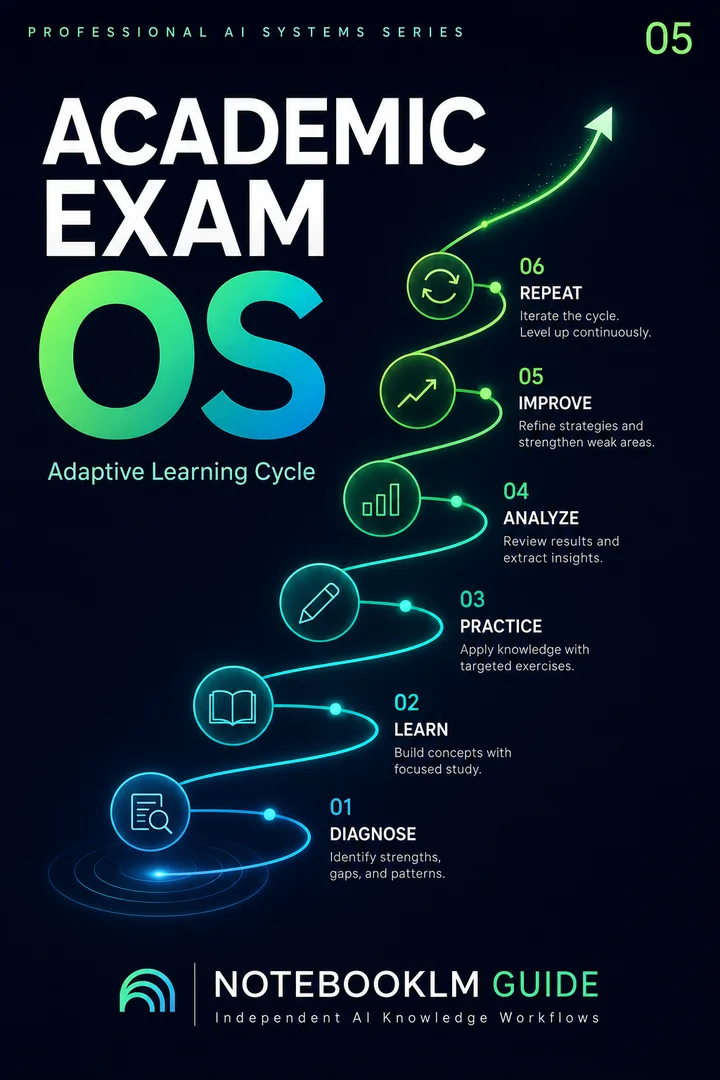
Academic Exam Prompt Package
A diagnostic study system for AP exams, GRE, SAT, and other academic tests.
- Reusable workflow architecture
- Source-grounded prompt patterns
- Implementation and review steps
- One-time purchase · permanent access
Become the student who sees the pattern before reading the answer choices
- Every analysis cites YOUR practice tests. NotebookLM constrains responses to your uploaded materials. Click any citation to verify. No invented shortcuts, no generic advice that doesn’t match how College Board writes questions.
- Pattern extraction beats brute-force practice 3-to-1. Doing 50 more practice problems without extracting patterns is like running on a treadmill — effort without progress. These prompts extract the patterns so every practice problem teaches you something transferable.
- The adaptive exam rewards speed AND accuracy. Module 2 difficulty is determined by Module 1 performance. These prompts build the recognition speed that gets you into the harder (higher-scoring) Module 2, and the accuracy to capitalize once you’re there.
- Audio Overviews turn dead time into SAT prep. Grammar rules, vocabulary clusters, math formula reviews — all listenable during your commute, workout, or before bed. One notebook, every format your schedule needs.
Full 100-prompt library below ↓
Unlock 30 expert prompts for SAT study.
Copy-paste prompts designed for NotebookLM’s source-grounded AI. Zero hallucination. Every answer cites your materials.
AP & Academic Bundle — $24.99 one-time
Explore the Academic Exam Prompt Package Explore the Academic Exam Prompt PackageNot a prompt list. A pattern-extraction system that reverse-engineers the Digital SAT from your own practice data.
70 universal prompts (7 phases) + SAT-specific blocks for Reading & Writing passage decoding, Math trap mechanism analysis, vocabulary-in-context building, and the 1500+ Last-100-Points Protocol.
AP & Academic Bundle — one-time access
Explore the Academic Exam Prompt Package Explore the Academic Exam Prompt PackageNotebookLM vs. ChatGPT vs. Khan Academy vs. private tutor
| Capability | NotebookLM + Prompts | ChatGPT | Khan Academy | Private Tutor ($150/hr) |
|---|---|---|---|---|
| Source-grounded analysis | ✓ Cites YOUR practice tests | ✗ Generic advice, can hallucinate | ✗ Pre-made content, not your data | ✓ Reviews your work |
| Pattern extraction from your errors | ✓ Automated trap mechanism analysis | Partial — can’t see your test history | Partial — adaptive but limited | ✓ Manual, slow, expensive |
| Vocabulary in context | ✓ Semantic clusters from your readings | Generic word lists | Standard flashcards | Depends on tutor |
| Audio review | ✓ Audio Overview grammar/vocab podcasts | ✗ Not available | ✗ Not available | ✗ Not available |
| Adaptive practice generation | ✓ Difficulty scales with your performance | Partial — no adaptive logic | ✓ Excellent adaptive system | ✓ Manual adaptation |
| Cost | Free tool + $24.99 prompts | $20/month | Free | $4,000–8,000 total |
Frequently asked questions
Can NotebookLM really help me score 1500+ on the SAT?
Is NotebookLM free? What does the $24.99 cover?
How is this different from Khan Academy SAT prep?
Will NotebookLM give me wrong answers or bad strategies?
What sources should I upload?
How many hours does this take?
Can NotebookLM generate slide decks for SAT review?
I’m a parent. Can I set this up for my child?
30 copy-ready AI prompts · one PDF
Thirty prompts you can paste today, sorted across research, content, Studio outputs and multi-AI work. Instant access. No credit card.