Read once. Query forever.
A 6-workflow NotebookLM system that turns every research paper into a persistent, queryable artifact — so you never re-read for the same project twice.
Upload each paper as a source, then query it forever instead of re-reading: NotebookLM builds a persistent, cited artifact you can decompose for methodology, findings, and gaps. A 6-workflow system lets researchers extract methods, compare studies, and build literature reviews — every answer grounded in the source text.
TL;DR — A 6-workflow NotebookLM system that turns every research paper into a persistent, queryable artifact. Free Methodology Decomposition prompt + 30 premium prompts for PhDs, postdocs, and faculty.
Updated June 2026. Maintained by a small team of AI super-users who teach multi-AI research and study workflows to researchers, students, and professionals — no affiliate relationships. About this guide →Changelog
Who this workflow is built for
Four academic profiles where the cost of re-reading is the real bottleneck. Each pill above scrolls to the workflow that solves the specific pain. The workflows themselves stack — doing all six on every paper is overkill; matching workflow to use-case is the point.
200-paper lit review
The cross-paper synthesis workflow turns a citation graveyard into a structured map of consensus, divergence, and gaps — before the writing starts.
Three grants in six weeks
The application workflow generates fundable research questions and method-transfer suggestions grounded in the corpus, so the grant draft writes itself.
Catching up after years away
The 5-minute screening workflow lets you triage 50 papers in an afternoon — what to deep-read, what to archive, what's already in your head.
No university library access
The knowledge-extraction workflow turns the few papers you can access into Anki cards, mind maps, and quotable passages — permanent intellectual capital.
The premise: reading is not the bottleneck. Re-reading is.
The traditional academic reading workflow looks like this. You read a paper. You take notes. The notes go into a citation manager. Two months later, you need that paper for a different project, and the notes don't have what you need now — so you re-read. Three months after that, you need the methodology section for a grant. You re-read. Six months later, a reviewer asks about a limitation. You re-read. A typical paper that matters to your field gets re-read four to six times across its useful life.
Each re-read costs forty minutes minimum. Across a hundred papers and a five-year project, that is hundreds of hours of redundant labor. The bottleneck is not the first read. The bottleneck is everything that happens after.
What the workflow does: it converts the paper, on first contact, into a persistent queryable artifact. The methodology decomposition lives in the notebook. The Anki cards live in your spaced-repetition system. The quotable passages live in your writing scratchpad. The mind map lives in your project file. Each of those artifacts is queryable — you ask the notebook the new question, you don't re-read the paper.
This reframes what NotebookLM is doing. It is not a summarization tool. It is a read-once persistence layer. The 4–5x speedup on reading time is real but secondary. The primary gain is the abolition of re-reading.
The 6-workflow pipeline: how a paper becomes an artifact
Each workflow operates on the paper at a different layer. The first read activates all six in roughly forty minutes. Every subsequent query goes to the artifacts, not back to the PDF.
Deep Research Protocol
A source-grounded research workflow for literature synthesis, evidence mapping, and defensible outputs.
- Reusable workflow architecture
- Source-grounded prompt patterns
- Implementation and review steps
- One-time purchase · permanent access
The six workflows, with copyable English prompts
Each workflow has a clear use case, an honest time estimate, and at least one inline prompt you can paste directly into NotebookLM chat. The featured prompt above is the highest-leverage one of the set — the others extend the same logic into different layers of the paper.
Screen & Triage
A 5-section value screen: three-sentence summary of what the paper actually does, scored novelty/methodology/evidence with one-line justifications each, and a deep-read/skim/archive recommendation. Calibrated toward false negatives.
Methodology Decomposition
Critical Evaluation
Generates three plausible alternative explanations the authors did not rule out, identifies which design feature would have ruled each out, and estimates how much of the headline effect could be re-attributed. Operates as a hostile but competent peer reviewer.
Knowledge Extraction
Generates 12–15 Anki-compatible flashcards in front/back/tag format, distributed across 6 card types (definition, mechanism, finding, limitation, methodology, quotable). Every card cites a specific page. Drop the .txt into Anki for permanent spaced-repetition memory.
Cross-Paper Synthesis
Application & Generation
Generates 3 fundable research questions grounded in your corpus’s gaps. Each question gets a feasible 2-year design, novelty/feasibility/significance scores, and a named NSF/NIH/NEH program where it would be competitive. The grant-writing postdoc’s starting weapon.
Go deeper
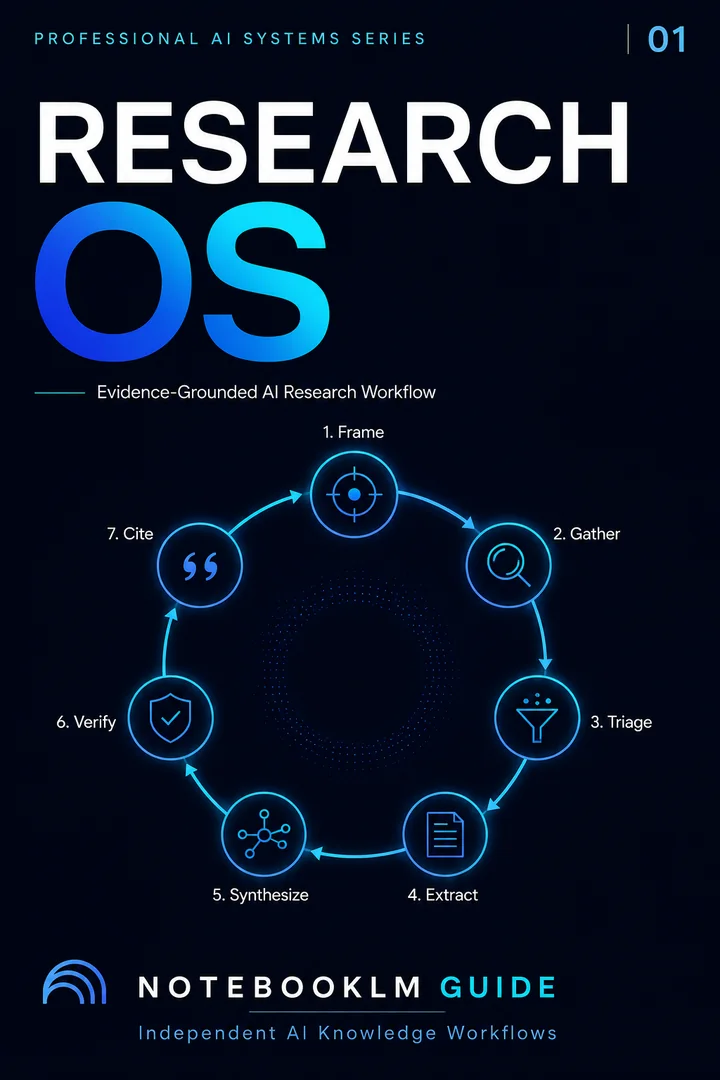
The Research OS
Every stage of the Grounded Research Loop as a tested prompt — Frame through Cite, plus the Evidence Matrix, Insight Matrix and Confidence Check.
Explore the Research Prompt PackageOne-time · Lifetime access · No subscription
Research Paper Reading OS
Thirty prompts covering every workflow above, plus the architectural notes that turn isolated prompts into a coherent reading system. Built for academics who run more than ten active reading projects at a time.
Screening & Value Audits
🔒 5 promptsFast triage protocols, novelty audits, target-reader alignment checks, citation-trail backwards traversal, and the 30-second elevator-pitch generator for sharing with collaborators.
Deep Structural Decomposition
🔒 5 promptsBeyond the featured methodology prompt: theoretical framework mapping, data and chart deep-reads, conversation-with-related-literature mode, and the assumption-stack extraction protocol.
Critical Evaluation & Evidence
🔒 5 promptsFull GRADE scoring, ethics-and-IRB analysis, conflict-of-interest scan, statistical robustness probes, and the research-gap-to-future-directions converter.
Knowledge Asset Generation
🔒 5 promptsThe full Anki six-card-type generator, mind-map MermaidJS code, quotable-passages bank with seven categories, cross-discipline translator, and field-impact projection.
Cross-Paper Synthesis
🔒 5 promptsMulti-paper comparison matrices, topic-evolution timelines, controversy and divergence detection, consensus mapping, and the literature-review outline auto-generator.
Application & Research Moves
🔒 5 promptsFundable-research-question generator, method-transfer suggestions across fields, practical-application scenarios (industry, policy, education), teaching-case development, and the grant-proposal seed generator.
Four habits that separate a working reading system from a graveyard of notebooks
One notebook per project, not per paper
The artifact-and-corpus design only pays off when papers sit alongside their siblings. A notebook per paper is a citation manager with extra steps. A notebook per project is a queryable research environment that compounds with every addition.
Run Workflow 02 on every paper that survives Workflow 01
Triage exists to protect the deep workflow. Once a paper passes triage, the methodology decomposition is non-negotiable. Half-decomposing a paper is worse than not decomposing it — you create a false sense of having engaged.
Keep the Anki deck active
Knowledge extraction is the highest-leverage workflow, and Anki is the only durable persistence layer. Twenty cards per paper, ten minutes of review per day, and after six months you have the field's structure in long-term memory rather than in PDFs.
Run the synthesis quarterly, not constantly
Cross-paper synthesis is the most expensive workflow. Running it every week wastes cycles. Running it once per quarter, on the full corpus that has accumulated, surfaces the patterns that the high-frequency runs miss. Discipline of cadence matters.
Traditional reading vs. the workflow
The 4–5x speed gain is real but secondary. The structural gain is the abolition of re-reading and the compounding of the corpus.
| Dimension | Traditional paper reading | The 6-workflow system |
|---|---|---|
| First-pass time | 2–3 hours | 40–45 minutes |
| Re-reads expected over project life | 4–6 per important paper | 0–1 (only for craft questions) |
| Output artifacts per paper | Notes in a citation manager | Methodology audit, Anki deck, quotable passages, mind map |
| Cross-paper analysis | Manual, prose-based, slow | Comparison matrix, timeline, divergence map — minutes |
| Recall after six months | Citation manager note, mostly forgotten | Long-term Anki memory + queryable corpus |
| Failure mode | Lost notes, redundant re-reading | Stale corpus if synthesis cadence drops |
The honest comparison: the workflow is more demanding on the first read — you do not just read, you actively construct artifacts. The payoff is the next six months, when none of those artifacts need to be re-built.
What the workflow does not solve
Honest limitations as of May 2026 — worth knowing before you commit a high-stakes review to the system.
The first read is still a first read. The workflow does not replace careful reading. It augments it and persists the result. If your reading discipline is poor, the artifacts inherit that poverty — an inattentive read produces a thin decomposition.
Heavily mathematical papers degrade. NotebookLM parses LaTeX-rendered equations well in PDF form, but proofs and dense derivations may still need a manual pass. The methodology decomposition works; the line-by-line math check does not.
Scanned PDFs and image-only papers are out of scope. Without good OCR, the model has no text to operate on. Use a separate OCR pass before upload, or skip the paper.
The synthesis prompts assume a meaningful corpus. Running cross-paper synthesis on three papers produces noise. Workflow 05 starts paying off at roughly fifteen papers in the notebook, and reaches its full value above thirty.
Long-term Anki review is on you. The workflow generates the deck. The spaced-repetition habit that makes the deck valuable is a separate practice. Without that habit, the cards sit unused.
FAQ
Get the 4 practical AI research workflows — free
The AI Research Starter Kit: four workflows, 13 ready-to-use prompts, and a 7-day plan. Instant delivery.
Four workflows · 13 ready-to-use prompts · 7-day plan
Start with four practical, source-grounded workflows, 13 ready-to-use prompts, and a 7-day plan. Instant access. No credit card.