GRE Diagnostic Study System: Turn Practice-Test Errors Into a Targeted Study Plan
A practice-test score tells you where you are. Your mistakes explain what to fix next. Use this five-type error taxonomy and six-step review loop to separate knowledge gaps from trap, timing, recognition, and execution problems.
Use the framework on this page for free. For reusable prompts covering GRE, SAT, AP, and other academic exams, explore the Academic Exam Prompt Package.
A GRE score plateau often persists because practice volume increases while the same error patterns remain untreated. Classify each miss as a knowledge gap, recognition failure, trap pattern, timing failure, or careless execution. Then match the intervention to the root cause and verify it on later practice.
- Practice Creates Information, Not Improvement
- Why Most GRE Study Plans Fail
- Exam Performance Taxonomy — 5 Error Types
- Build Your Personal Error Database
- The Diagnostic Study Workflow (Human + AI)
- What's Inside the Diagnostic System
- How to Review GRE Practice Tests Effectively
- How to Break a GRE Score Plateau
- Case Study: A Diagnostic Journey
- The Diagnostic Learning Loop
- FAQ
Practice creates evidence. Diagnosis turns it into improvement.
Many students treat a practice test primarily as a readiness score. The score matters, but it does not identify the intervention that should come next. The useful part is every wrong answer, every hesitation, every question where you guessed between two options.
Repetition becomes useful when the information it creates is diagnosed, corrected, and tested again.
Why most GRE study plans fail
Most GRE students follow the same cycle: buy a book, do questions, take a mock exam, see a disappointing score, then do it all again. The problem isn't effort. The problem is that none of these methods tell you why you missed the questions you missed.
Doing More Questions
Volume without diagnosis can reinforce the same mistake. When a recurring trap pattern is the cause, more questions help only when the review process teaches you to recognize that pattern.
Memorizing Vocabulary
Alphabetical flashcards teach definitions. The GRE tests near-synonym discrimination — knowing which of five similar words fits one specific sentence context.
Watching Video Courses
Passive delivery can't identify your personal error patterns. A video doesn't know that you specifically keep falling for "Almost Right" answers in Quantitative Comparison.
Taking Another Mock Exam
New data comes in, but nobody reads it. Without systematic error classification, a practice test score is just a number — it tells you where you are, not how to move forward.
Exam Performance Taxonomy™
Core FrameworkFor this framework, GRE errors are first separated into two broad categories. Knowledge Problems mean you didn't know something. Performance Problems mean you knew it but didn't execute. The fix for each is completely different, and confusing them wastes weeks of study time.
You Didn't Know
You Knew It But Didn't Execute
Build your personal error database
Diagnostic FlowEvery practice question you've ever missed is a data point. The six-step diagnostic flow transforms raw mistakes into structured intelligence about your specific weaknesses.
Step 1
Question
Capture the question you missed — section, sub-type, difficulty level, and the question text.
Step 2
Observable Error
What actually went wrong? You chose B instead of D. You spent 4 minutes on a 1.5-minute question. You solved for x when the question asked for 2x + 3.
Step 3
Root Cause
Classify using the Exam Performance Taxonomy: Knowledge Gap, Recognition Failure, Trap Pattern, Timing Failure, or Careless Execution. This is the step most students skip.
Step 4
Recurring Pattern
Is this a one-time miss or a pattern? If you've fallen for the same trap mechanism three times, it's not bad luck — it's a system vulnerability.
Step 5
Corrective Action
Based on the cause, choose the right fix. Knowledge Gap → learn the concept. Trap Pattern → practice 10 problems with the same trap. Timing Failure → speed drills with a stopwatch.
Step 6
Verified
After the intervention, did the error disappear? If yes, move to the next pattern. If no, the diagnosis was wrong — reclassify and try a different intervention.
The diagnostic study workflow
Human + AIAI doesn't replace your study — it amplifies your diagnosis. This is a Human-AI partnership: you make decisions and do the work, while AI handles the pattern analysis that would take hours to do manually.
The workflow can use NotebookLM as a source-grounded workspace. When you provide answer explanations, practice-test notes, and your own error log, NotebookLM can organize its response around those sources. Always check the classification against the original question and official explanation.
Build your diagnostic toolkit
Root Cause Analyzer
Upload your practice test results. The analyzer classifies every error by type, maps section-level and sub-type weaknesses, and ranks them by point impact.
Vocabulary Pattern Extractor
Groups GRE vocabulary into semantic clusters — words that share a core meaning but differ in nuance. Generates discrimination sentences where only one word fits.
Error Mechanism Analyzer
Identifies recurring Quant trap patterns: Almost Right answers, unit switches, extraneous roots, percent-of-percent traps. Generates "trap alarm" sentences for each.
Weekly Review Dashboard
A structured template for your weekly diagnostic review. Tracks metrics, flags repeating patterns, and generates an updated study plan for the coming week.
How to review GRE practice tests effectively
Weekly SystemA weekly review turns isolated mistakes into trends. Track a small set of metrics, decide which pattern matters most, and update the next week's study plan based on evidence rather than intuition.
| Metric | This Week | Last Week | Trend |
|---|---|---|---|
| Top 5 recurring mistakes | 3 active | 5 active | ↓ Improving |
| Avg. solving time (Verbal) | 1:45 | 2:10 | ↓ Faster |
| Text Completion accuracy | 72% | 58% | ↑ +14% |
| Trap frequency (Quant) | 4 / 20 | 7 / 20 | ↓ Fewer traps |
| RC inference accuracy | 60% | 55% | → Stalling |
| Confidence rating (self-assessed) | 3.8 / 5 | 2.9 / 5 | ↑ Growing |
Weekly Decision Point
Are your repeated errors actually decreasing?
How to break a GRE score plateau
If your score has been stuck for weeks, more practice questions won't break the plateau. The next level requires fewer questions and better diagnosis. A similar pattern can appear across many standardized exams: adding volume is less useful than identifying the next correct intervention.
Academic Exam Prompt Package
A diagnostic study system for AP exams, GRE, SAT, and other academic tests.
- Reusable workflow architecture
- Source-grounded prompt patterns
- Implementation and review steps
- One-time purchase · permanent access
Illustrative scenario: a diagnostic journey
Representative ExampleThe following hypothetical scenario shows how a diagnostic workflow could evolve across four review cycles. It is an illustration, not a documented student result or score forecast.
"Sarah" is fictional. The scores and timeline are examples used to explain the workflow; they do not represent a performance guarantee.
Baseline
Score: 312
Diagnostic: TC double-blank accuracy = 30%. Quant "Almost Right" trap errors = 6/20. RC inference timed out on 4 of 8. She assumed she needed more vocabulary. The diagnosis said otherwise.
Week 1 — Diagnosis & Initial Drills
Score: 314
Almost no movement — she questioned whether the system was working. But the error database revealed: 4 of 7 TC errors were Trap Pattern, not vocabulary deficit. She didn't need more words — she needed to stop picking near-synonyms that fit one blank but not both.
Week 2 — Semantic Clustering Focus
Score: 318
TC double-blank accuracy rose to 50%. Semantic cluster drills worked — she could discriminate between "castigate" (8/10 intensity) and "admonish" (3/10) in context. But a new problem exposed: RC inference accuracy = 40%, masked earlier by the TC issues.
Week 3 — RC + Quant Trap Training
Score: 325
The illustrative model shows a larger change at this stage. RC inference time dropped from 3.5 min to 1.8 min per question. Quant trap alarm sentences eliminated 3 of 6 "Almost Right" errors. In the scenario, she could explain why she was improving, not just that she was.
Week 4 — Final Sprint
Score: 332
The final review focused on the remaining Quantitative Comparison “Cannot Be Determined” pattern, which had been masked by larger weaknesses earlier in the process.
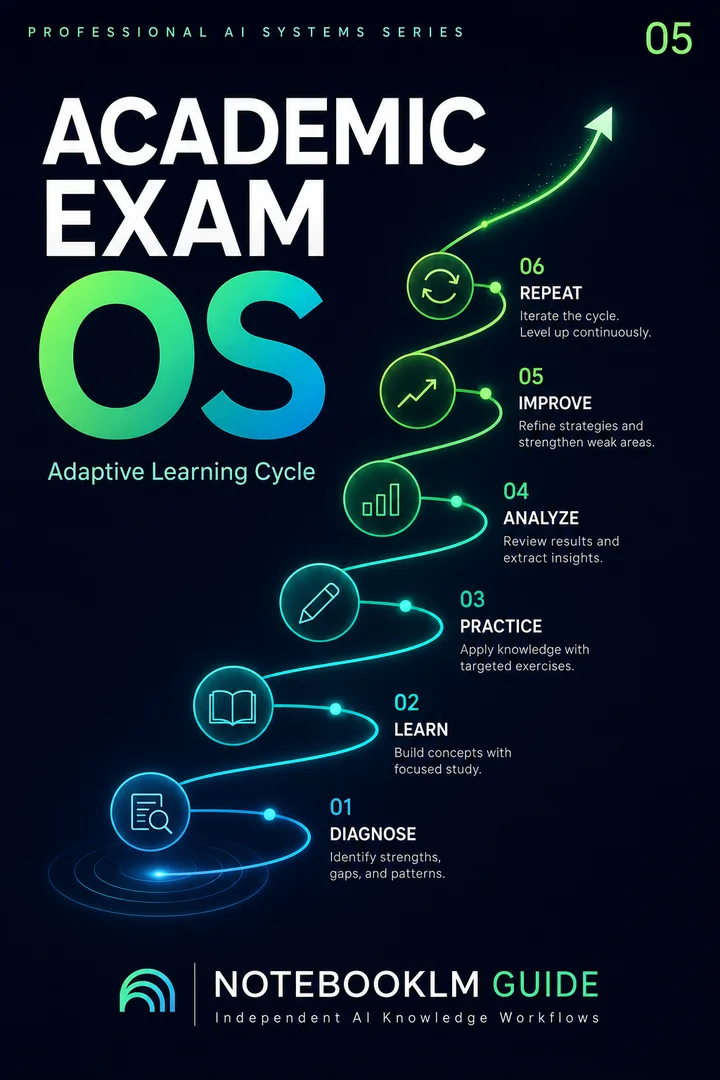
The Diagnostic Learning Loop
Exam OS MethodologyThis is the methodology behind the entire system. It is designed for the GRE and can be adapted to many other exams when their question types, timing rules, and official guidance are handled separately. The loop never ends — each cycle makes the next one more precise.
Use the Diagnostic Method Across Your Academic-Exam Workflow
This GRE guide is free. The category package provides reusable prompts and workflows for GRE, SAT, AP, and other academic exams rather than selling a separate GRE product.
- Practice-test diagnostic and root-cause prompts
- Error-log, weekly review, and study-planning workflows
- Prompts adaptable across academic exam categories
- Human-review checkpoints for AI-generated analysis
- One category package — not separate topic purchases
Academic exam category
The same diagnostic logic can be adapted across GRE, SAT, AP, and other academic exams. The category package centralizes reusable prompts and workflows; individual guide pages remain free educational resources.
Explore the Academic Exam Prompt Package →Choose your next step
Frequently asked questions
30 copy-ready AI prompts · one PDF
Thirty prompts you can paste today, sorted across research, content, Studio outputs and multi-AI work. Instant access. No credit card.