The Grounded Research Loop: Where AI-Assisted Research Actually Breaks
AI hasn't changed what good research is. It has changed where the mistakes happen. One loop, five places researchers fall out of it.
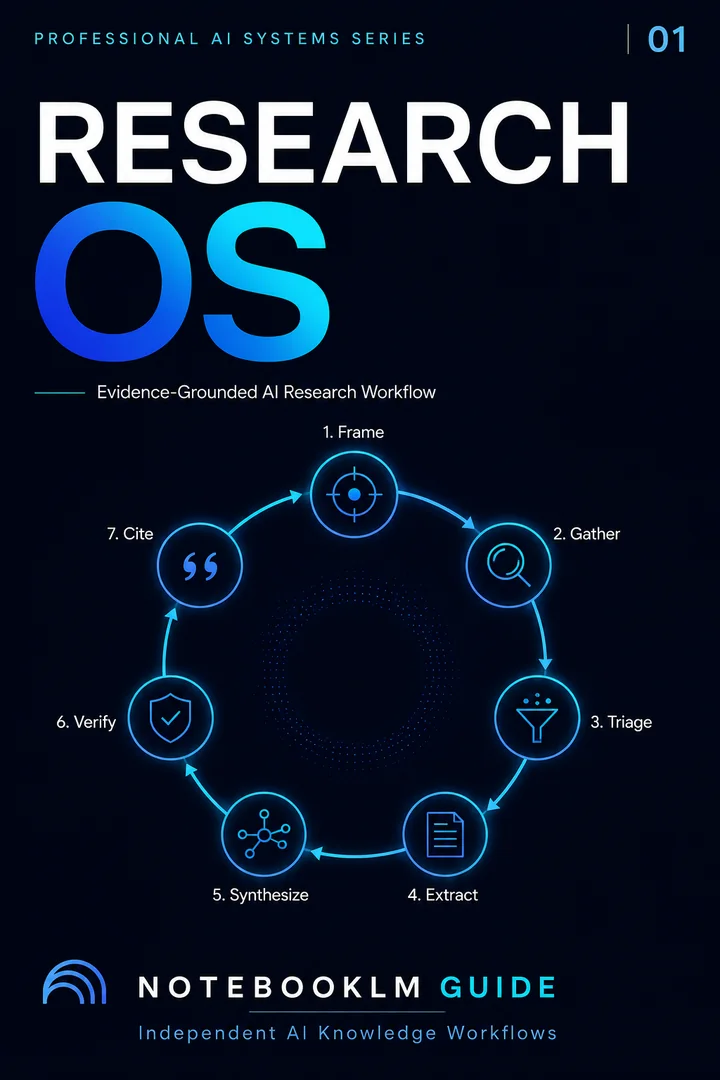
This isn't five unrelated tips. It's one loop — Frame, Gather, Triage, Extract, Synthesize, Verify, Cite — and the five places AI-assisted research most often breaks out of it.
TL;DR — Most weak AI research output isn't a prompting problem — it's a loop problem. I used to treat the first AI summary as settled. Now every research task runs through the Grounded Research Loop — Frame, Gather, Triage, Extract, Synthesize, Verify, Cite — before anything reaches a draft. This page walks the loop stage by stage, with a free workflow card and four more inside the Studio Command Center, or start with the free Professional AI Starter Kit.
Updated July 2026. Maintained by a small team of AI super-users who teach multi-AI research and study workflows — no affiliate relationships. About this guide →
Watch the loop stage by stage
Frame, Gather, Triage, Extract, Synthesize, Verify, Cite — walked through in order, with the reasoning behind each stage.
The Grounded Research Loop™
Most advice about AI and research focuses on prompts. That's the wrong unit. A prompt is one sentence. Research is a loop — you ask something, anchor it in real evidence, reason through what you've found, challenge your own reading of it, and only then decide what to claim. AI can accelerate every stage of that loop. It can't run the loop for you, and it can't tell you when you've quietly skipped a stage.
The full method: Research with AI — The Grounded Research Loop, all seven stages with the prompts and artifacts.
The five mistakes below aren't independent. Each one is what happens when a researcher exits the loop at a specific stage — skips it, rushes it, or trusts AI to do it unsupervised. Once you can see which stage broke, the fix is usually obvious.
In five minutes you'll know where most AI-assisted research goes wrong
If you're here for a quick fix, start with the loop above. It gives AI a clearer research question before generation and gives you a faster way to verify what comes back.
Is this why you're here?
Mistake #1 — Treating AI like a search engine instead of a workflow
The pattern is familiar: type a broad question into an AI tool — "summarize the literature on X" — get back a broad answer, and either accept it or rephrase the same question hoping for something sharper. A few rounds later you have several plausible-sounding paragraphs and no clearer sense of your own argument than when you started.
That's not a prompting failure. AI is genuinely good at synthesizing what it's given — the thinking behind the request is what's still unfinished. This is the Frame stage of the loop, and it's the one people skip most often. For a long time I blamed the prompt whenever an answer felt generic, rewrote it, and hoped the next version would guess what I actually needed. Sometimes it did. More often I was asking AI to answer a question I hadn't answered myself: what, specifically, am I trying to find out?
A generic answer is almost always a symptom of a skipped Frame stage. Before opening any AI tool now, I close it — the specific question this task must answer, why it matters to my project, and what decision or output it should produce. It takes under five minutes and it's the highest-return five minutes in the loop.
Try this once — close the Frame stage
Before opening any AI tool, write four lines in a blank doc:
Research question
The specific question this task answers — not the general topic.
Why it matters
How this connects to your larger project, chapter, or argument.
The decision it supports
What should be different once this task is done — a gap identified, a claim tested, a section drafted.
Evidence needed
What kind of evidence would actually move this question forward — not every interesting fact available.
Then prompt exactly as you normally would. The first response won't look dramatically different. The gap shows up a few exchanges in — instead of asking "why is this still so generic," you'll be asking "how do I tighten this further." That's a much better problem to have.
Mistake #2 — Uploading your entire library instead of curating sources
More sources feels safer, especially with a deadline approaching. But this is the Triage stage — where the work gets anchored in evidence — and AI doesn't distinguish background reading from load-bearing evidence. It treats everything you upload as equally important. Feed it forty papers across six loosely related themes and it tries to honor all six. The synthesis reads as comprehensive and lands as unfocused.
A weak Triage stage contaminates everything downstream: you can't Synthesize cleanly over noise, and you can't Challenge a conclusion that was built on the wrong sources. So I stopped asking "what else should I add" and started asking "what can I remove without weakening this argument." That single swap turns a notebook from a storage folder into a working set with one job: support one line of reasoning.
Ground it — sort before you upload
Essential
Directly tests or supports your research question — can't be removed without changing the argument.
Helpful
Useful theoretical or background framing, not load-bearing — prior literature, adjacent studies.
Noise
Interesting, unlikely to change the conclusion — duplicate findings, tangential fields, old drafts.
Upload only the essential group first, generate a synthesis, then add from the helpful group one document at a time if something's genuinely missing. Two studies reporting nearly identical findings — an 11% versus 12% effect size — read as one data point to a human and as two independent signals to AI. Removing the redundant one usually sharpens the synthesis rather than weakening it.
Mistake #3 — Accepting the first summary as verified fact
The Verify stage exists to stop weak evidence from becoming strong claims — and it's the stage a fluent summary tempts you to skip entirely. The first AI-generated summary that reads as genuinely polished and well-organized is exactly the one worth being most careful with. Confident, well-structured prose is psychologically persuasive; it feels checked even when nothing has actually been verified. A misattributed finding, or a citation that doesn't quite say what the summary claims, can sit undetected for weeks inside otherwise excellent writing.
Reasoning isn't judging how the summary reads — it's tracing every claim back to its source. Judging asks "does this sound right." Reasoning asks "does the original paper actually say this, and does the citation exist at all." Those are very different questions, and only one of them protects your credibility.
Reason it through — the five-question verification pass
Does this citation actually exist?
Search for it independently by title and author before relying on it.
Does the summary match the original claim?
Not just the topic — the specific finding, direction, and magnitude.
Is the methodology described accurately?
A common failure mode is conflating similar studies' designs.
Would the original author recognize this framing?
If the emphasis feels off, go back to the source paragraph.
What's missing that would change the conclusion?
Ask what a more cautious reading of the same source would say.
Run this before a claim goes into a draft, not after. A fabricated or misattributed citation is far cheaper to catch on your own screen than in front of a committee, an editor, or a client.
Same sources, different loop
An illustrative example — not real citations, just a pattern that shows up constantly. Same two sources, same question. The only thing that changed is whether the Verify stage happened.
"Studies show remote work consistently improves productivity, with gains reported across most industries. Researchers agree this makes flexible policies the clear choice for organizations going forward."
"Two studies report productivity gains from remote work, but the effect sizes differ (8% vs. 15%) and neither controls for role type. The claim that this generalizes across industries isn't yet supported by these two sources alone."
Mistake #4 — Asking AI to find research gaps without mapping the field first
Asked cold — "what are the research gaps in this area" — AI tends to produce gaps that sound plausible but aren't grounded in what's actually been published. They're generic enough to apply to half the field, which usually means they won't survive contact with an advisor who actually knows the literature. This is the Synthesize stage, and it fails when it's attempted out of order.
The Synthesize stage begins only after the Triage stage is complete. Map the existing conversation first — dominant methods, recurring limitations, shared assumptions across your sources — and only then ask what hasn't been resolved. Gaps that come out the other side of that sequence are specific, sourced, and defensible instead of generic. Challenge isn't a better prompt; it's a stage you can't skip ahead to.
Challenge it — map before you gap
Before asking for gaps, ask AI to summarize what your uploaded sources agree on, where they conflict, and which limitations show up more than once. Only then ask what remains unanswered — and for each gap, ask why it exists and who would actually benefit from it being filled.
Mistake #5 — Never stress-testing conclusions against a skeptical reviewer
The draft was never the product — the defense of it was. The Cite stage is where you commit to a claim, and committing without stress-testing is how weak conclusions reach a room. A committee, reviewer, or client never experiences your research as a document sitting quietly on their desk; they experience it as a series of challenges, and your argument either survives them or it doesn't.
Decide well and you close the loop; decide carelessly and you skip straight to Claim without earning it. Before anything high-stakes, I read the finished draft start to finish without editing, asking only: if I knew nothing about this topic, where would I get confused or unconvinced? That catches more than another round of polishing — a claim leaning on a citation I never double-checked, a term obvious to me after months but not to a first-time reader.
Then I hand the draft back to AI one more time, but as a critic rather than a collaborator: if you were the toughest reviewer this work could get, what would you challenge in each section? Occasionally it surfaces a genuine contradiction between two claims. Far better to find that the week before submission than during the defense.
Deep Research Protocol
A source-grounded research workflow for literature synthesis, evidence mapping, and defensible outputs.
- Reusable workflow architecture
- Source-grounded prompt patterns
- Implementation and review steps
- One-time purchase · permanent access
What changed after running the full loop
A literature review started as a notebook with 40 uploaded sources spanning several loosely related themes. Verification caught two misattributed citations before they reached a draft. After sorting sources into essential and helpful, mapping the field before asking for gaps, and running the adversarial-reviewer prompt, the working source set narrowed and the argument tightened considerably.
The biggest change wasn't the citation count. It was that the central claim survived a skeptical read before anyone else saw it.
Free workflow card: adversarial peer-review check
This is the single card from the loop above that catches the most problems for the least effort — run it against any draft, summary, or argument before you submit or present it. It maps to Stage 5, Decide.
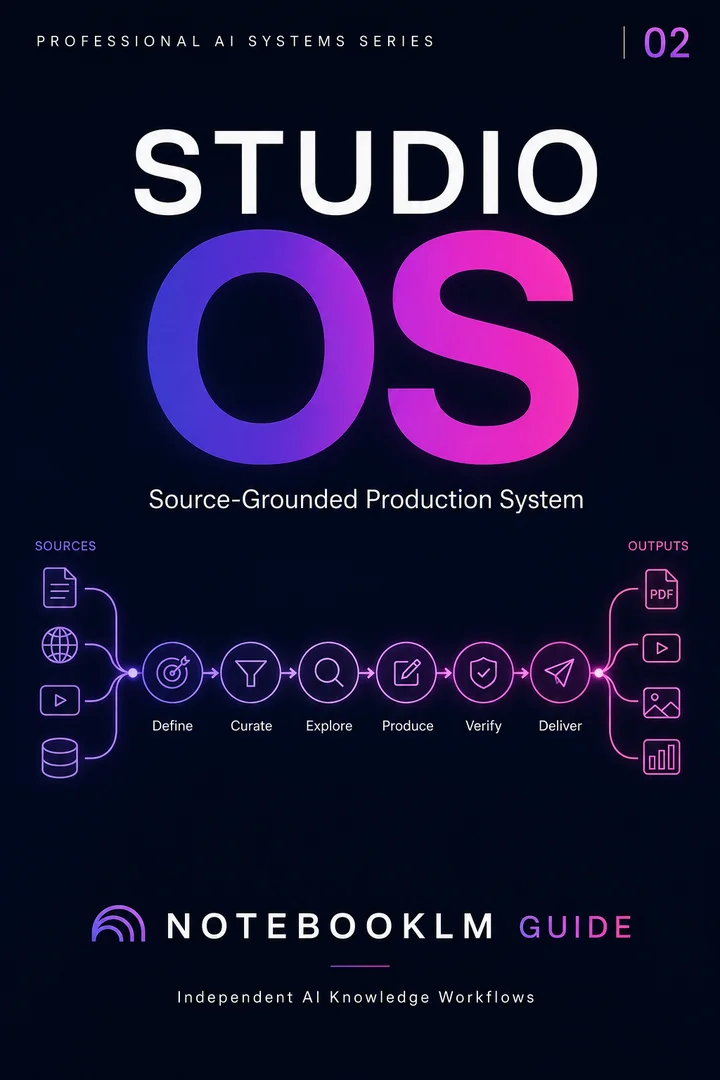
The other four Workflow Cards I run on every research project
Source-triage, citation-verification, field-mapped gap analysis, and committee Q&A rehearsal — the exact cards behind mistakes #2 through #5, ready to paste. Prompts are the implementation; the card is the reusable unit.
See all premium bundles → · Or get everything — Sovereign OS, $69.99 one-time →
AI is excellent at synthesis. It has no way of knowing which claims your field will actually challenge — only your own workflow can catch that.
Final checklist before you submit
Print this before your next AI-assisted research task
Run through this once before submitting, presenting, or defending. It is deliberately short: the point is to catch the problems that create the most rework — and the most risk.
AI can dramatically reduce the time it takes to synthesize a literature base. It cannot decide whether your argument is defensible. That remains your job.
The bigger idea
AI hasn't changed what good research is. It has changed where the mistakes happen.
Twenty years ago, researchers spent most of their time collecting information — finding the paper, requesting the article, tracking down the dataset. Today that part takes minutes. What's left is everything collection used to protect you from having to do carefully: deciding what a source actually shows, deciding which gap is real, deciding whether a claim survives scrutiny.
That means the durable skill was never the prompt. It's the judgment that runs the loop — Frame, Gather, Triage, Extract, Synthesize, Verify, Cite — the willingness to ground a claim before trusting it, and to challenge a conclusion before publishing it. Prompts will keep changing. Models will keep changing. The loop, and the judgment to run it honestly, is what stays yours.
And notice those seven words aren't really about research. Frame, Gather, Triage, Extract, Synthesize, Verify, Cite — that's how you'd approach a dissertation chapter, a client recommendation, a lesson you're learning, or any decision worth getting right. We call it the Grounded Research Loop here because research is where the mistakes are most expensive. It's really just how careful people think.
Frequently asked questions
Four workflows · 13 ready-to-use prompts · 7-day plan
Start with four practical, source-grounded workflows, 13 ready-to-use prompts, and a 7-day plan. Instant access. No credit card.