Become the Brand That AI Engines Quote by Name: The NotebookLM GEO Sandbox for Citation Domination
AI search engines don’t rank pages — they cite sources. When Perplexity answers a question, it cites 3–5 sources inline. The winning content isn’t the highest-authority domain — it’s the content whose structure, specificity, and directness most closely matches what the AI needs. NotebookLM uses the same RAG architecture. Test here first. Get cited everywhere after.
Use NotebookLM as a private GEO sandbox to make ChatGPT, Perplexity, and Gemini quote your brand: simulate how AI engines cite, test content formats, and structure pages for extraction. You iterate on citability privately before publishing, grounded in your own content.
TL;DR — Make ChatGPT, Perplexity, and Gemini cite YOUR content. NotebookLM as a private GEO sandbox: simulate AI citations, test content structure, run competitor gap analysis. 10 strategies for Generative Engine Optimization. 1 free prompts. Updated March 2026.
Updated June 2026. Maintained by a small team of AI super-users who teach multi-AI research and study workflows to researchers, students, and professionals — no affiliate relationships. About this guide →Changelog
For SEO Teams Entering GEO
Your rankings are fine. Your AI citations are zero. That’s a growing visibility gap. This guide teaches the 6 citation signals AI engines reward and how to test them privately before publishing.
Jump to SEO vs. GEO →For Content Strategists
Upload your draft + 10–20 competitor sources. Query NotebookLM as if it were Perplexity. See exactly how (or if) your content gets cited. Iterate until you win. Zero risk, full control.
Start with Citation Sandbox →For Founders & Marketers
Entity building: position your brand as the authoritative source for your niche query. Precise jargon, original frameworks, data tables — the elements 2026 LLMs favor for credible citations.
Jump to Entity Building →For Content Teams
Create 3 content variants in one notebook — traditional SEO, heavy Q&A + lists, framework-heavy with tables. See which gets cited. Private A/B testing for AI search.
Jump to A/B Variants →Try the sandbox right now
Open NotebookLM, paste the Citation Simulation prompt. See who gets cited and why. Then read the 10 strategies below to win every time.
Start with Strategy 1 →SEO vs. GEO: what changes in 2026
| Dimension | Traditional SEO | GEO / AEO |
|---|---|---|
| Goal | Earn a position in a ranked list of 10 links | Earn a citation in a synthesized AI answer (3–5 sources) |
| Signals | Backlinks, domain authority, keyword density | Structure, specificity, directness, quotable chunks |
| Winner | Highest-authority domain | Content whose structure matches what the AI needs |
| Format | Long-form, keyword-optimized prose | Answer-first, modular nodes, bold subheads, tables, numbered steps |
| Testing | Wait weeks for Google to re-index | Simulate privately in NotebookLM → iterate → publish |
The 6 signals that make content citable by AI engines
1. Answer-first structure — Every section opens with a direct 40–60 word answer before elaborating. AI engines extract the first confident statement they find.
2. Scannable formatting — Bold subheads, numbered steps, comparison tables, pros/cons lists. LLMs can extract these verbatim.
3. Specific data — Statistics, percentages, dates, named examples. AI engines prefer content with verifiable, precise claims over generic assertions.
4. Entity consistency — Consistent brand/topic naming across the page. AI engines build entity graphs; inconsistency confuses them.
5. Modular content nodes — Each H2/H3 section is a self-contained 75–300 word chunk that makes sense without surrounding context. AI engines cite sections, not pages.
6. Freshness — Recent dates, updated statistics, “2026” in titles and content. AI engines prioritize maintained content.
Upload your draft article plus 10–20 competitor sources (or let Deep Research fetch them). Then query NotebookLM as if it were Perplexity or Gemini. It answers, cites sources inline, and reveals why it chose or ignored certain ones. Iterate by tweaking structure — add headings, lists, tables — and re-test until your content wins the citation.
Upload top-ranking pages for your target query alongside your own content. NotebookLM performs a meta-analysis of which sources a generative engine would most likely cite — and why. Then it identifies gaps in competitor content that your piece can fill with authoritative, quotable elements (stats, frameworks, comparisons).
Test different formats in the same notebook: plain text vs. FAQ-style questions, bullet lists, comparison tables, or layered sections. NotebookLM shows you which version is easier to cite verbatim. GEO winners in 2026 use scannable, chunkable structures that LLMs can easily extract.
Feed NotebookLM your draft plus related user questions (from People Also Ask, Reddit, or Deep Research). It generates 20–30 semantic variations of your main query and evaluates how comprehensively your content answers each one. This turns one page into an “answer hub” that satisfies multiple AI prompts.
Upload brand assets (guidelines, testimonials, data, case studies) alongside niche research. NotebookLM simulates how an AI engine would position your brand. Iterate to include precise jargon, original frameworks, and data tables — the elements 2026 LLMs favor for credible citations over generic content.
Premium strategy — the entity-building prompts produce brand positioning that makes AI engines mention you by name.
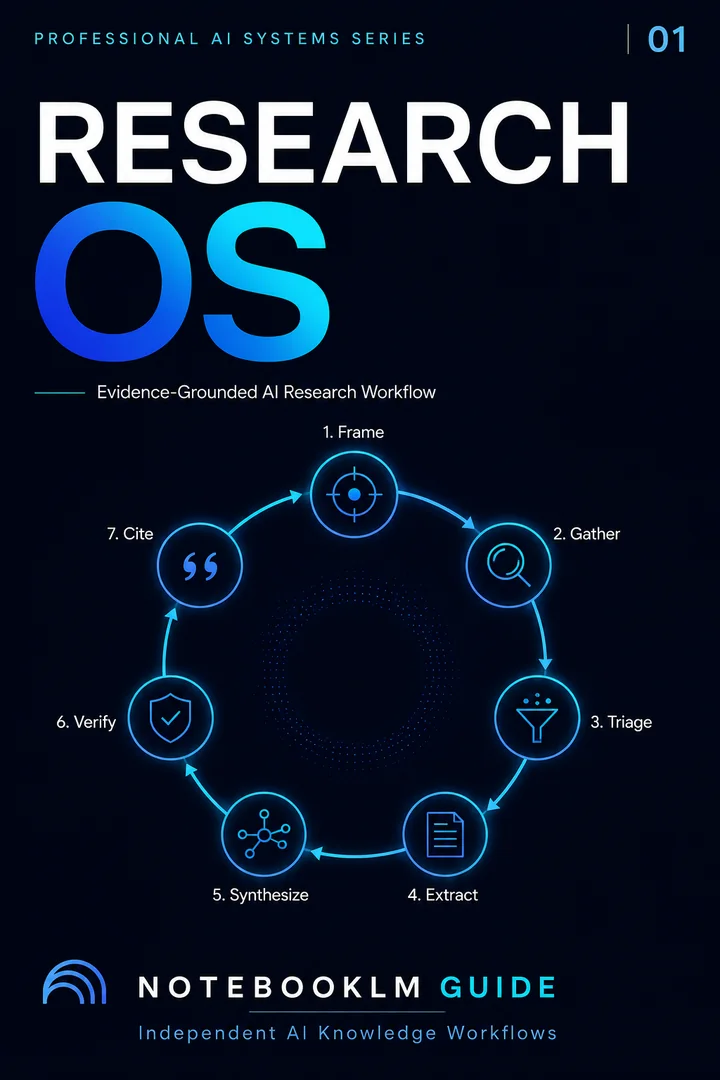
Deep Research Protocol
A source-grounded research workflow for literature synthesis, evidence mapping, and defensible outputs.
- Reusable workflow architecture
- Source-grounded prompt patterns
- Implementation and review steps
- One-time purchase · permanent access
After optimizing a core piece, use Studio tools to generate Audio Overview (podcast-style), Slide Deck, Infographic Guide, or Video Overview. Each format feeds back into AI ecosystems — transcripts get cited, slides get embedded, audio gets referenced. The same grounded research reaches every AI engine in its preferred format.
See the Content Alchemist for the complete 1-source → 30-assets pipeline.
Start with Deep Research on your topic (auto-fetches 100+ sources). Add your draft. NotebookLM synthesizes a PhD-level response with fresh data and citations, then highlights where your draft adds unique value or needs more density. LLMs in 2026 prioritize content with rich, verifiable data — this workflow creates exactly that.
See Deep Research Strategy for the complete data extraction pipeline.
Upload an old high-performing page + new 2026 sources. NotebookLM simulates how current AI engines would cite the old vs. updated version. Then it generates a refreshed draft with “2026 Updated” elements. This exploits AI preference for fresh, maintained content while preserving your existing authority signals.
See Gemini Hub Content Refresh for the full two-tool pipeline with live SERP analysis.
Create multiple draft variants in one notebook: Version A (traditional SEO), Version B (heavy Q&A + lists), Version C (framework-heavy with tables). Ask NotebookLM to cite each variant for the same query. It ranks them by citation probability and explains the winning patterns. Rapid, private A/B testing reveals what actually gets quoted in generative responses.
Premium strategy — includes variant templates and scoring rubrics.
Build a “Master GEO Notebook” with your brand voice, past top-cited content, and competitor examples. NotebookLM creates a reusable prompt template library for testing any new content. Then it applies the library to your latest draft and outputs an optimized final version plus measurement criteria (quotable chunks, entity strength, citation probability score).
Premium strategy — the Master GEO Notebook becomes your team’s permanent optimization engine.
Make AI engines — ChatGPT, Perplexity, Gemini — cite your content as the authoritative source in their answers
- AI-generated answers are replacing search results. When ChatGPT or Perplexity answers a question, they cite sources. Being that cited source is the new #1 ranking.
- GEO requires different optimization than SEO. AI engines evaluate authority, structure, and citation-worthiness — not just keywords and backlinks.
- NotebookLM as a citation sandbox. Test whether AI would cite your content by uploading it to NotebookLM and asking questions. If it cites you, AI engines will too.
Full GEO strategy library below ↓
Unlock the Full Prompt Collection
Cross-source synthesis, multimodal extraction, slide optimization, Studio customization, troubleshooting diagnostics, and advanced multi-AI workflows — for researchers, business professionals, and educators.
Strategy Bundle — one-time access
Explore the Content Prompt Package PDF → Markdown Innovation Detonator Source RefreshFrequently asked questions
30 copy-ready AI prompts · one PDF
Thirty prompts you can paste today, sorted across research, content, Studio outputs and multi-AI work. Instant access. No credit card.