Master USMLE Steps 1, 2 CK & 3 with NotebookLM — The Agentic Study OS
You’re drowning in First Aid highlights, half-finished UWorld blocks, and forgotten Pathoma videos. Meanwhile, the top scorers are turning every resource into custom podcasts, grounded quizzes, instant slide decks, and anti-hallucination synthesis — cutting passive study by 60–70% while boosting retention.
Upload First Aid, UWorld, Pathoma, and Sketchy into NotebookLM and turn them into grounded synthesis tables, custom audio, quiz ladders, mind maps, and decks for Steps 1, 2 CK, and 3. Agentic workflows tie your resources together — every output cited to your sources.
TL;DR — Master USMLE Steps 1, 2 CK and 3 with NotebookLM agentic workflows. Turn First Aid 2026, UWorld, Pathoma, and Sketchy into grounded synthesis tables, custom audio podcasts, quiz ladders, mind maps, and slide decks. 50+ expert prompts. 1 free teaser. Cut passive study by 60%. Updated April 2026.
Updated June 2026. Maintained by a small team of AI super-users who teach multi-AI research and study workflows to researchers, students, and professionals — no affiliate relationships. About this guide →Changelog
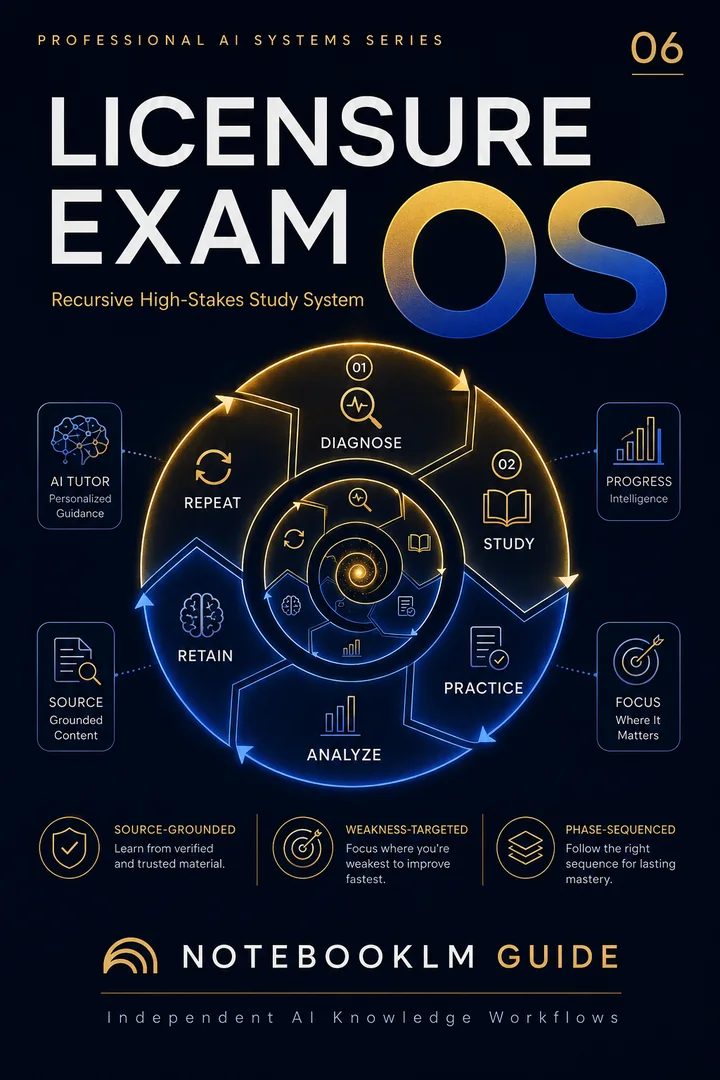
Licensure Exam Protocol
Diagnostic and review workflows for licensure, professional, and high-stakes knowledge exams.
- Reusable workflow architecture
- Source-grounded prompt patterns
- Implementation and review steps
- One-time purchase · permanent access
Who becomes a more efficient USMLE candidate with this system?
For Step 1 Foundations
Upload First Aid + Pathoma + Sketchy. Generate synthesis tables, audio podcasts for commute review, and quiz ladders that escalate from first-order facts to complex vignettes.
Step 1 prompts →For Step 2 CK Clinical Mastery
Upload UWorld explanations + clinical guidelines. Generate differential diagnosis tables, CCS case simulations, and management algorithm flowcharts — all citing your sources.
Step 2 CK prompts →For Step 3 & CCS
Upload Step 3 review materials + CCS case banks. Generate timed CCS simulations, biostats cheat sheets, and ambulatory medicine synthesis notes.
Step 3 prompts →Not sure where to start?
Are you an IMG or US MD? Weak in biochem or clinical reasoning? Step 1 foundations or Step 2 CK? Answer one question and get routed to the right prompt set.
See FAQ below →The 6-stage USMLE agentic study pipeline
Why does source-grounded AI change USMLE prep?
You’ve probably tried pasting a First Aid page into ChatGPT and asking it to explain a pathway. The result is plausible but potentially wrong — ChatGPT may hallucinate enzyme names, invent drug interactions, or conflate Step 1 and Step 2 CK emphasis. On boards, one wrong mechanism can cascade into 3–5 missed questions.
NotebookLM is different in three critical ways. First, every response is grounded in citations to your uploaded First Aid pages, UWorld explanations, and Pathoma chapters — click any claim to see the exact source. Second, it cannot hallucinate pathways because it’s constrained to your documents. Third, its Studio panel produces flashcards, quizzes, mind maps, slide decks, and Audio Overviews that no open-web AI can match.
The mathematics of agentic study are compelling: students who use active recall with source-grounded synthesis retain 2–3x more than passive re-readers. When you combine grounded synthesis + audio immersion + quiz laddering + visual slide decks, you create a multi-modal encoding stack that exploits how the brain actually stores and retrieves medical knowledge.
Step 1 Foundations: Biochem, Pathology & Pharmacology
The notebook architecture
Create one notebook per organ system (Cardiology, Renal, GI, Neuro, etc.) plus one for Biochemistry, one for Pharmacology, and one for Behavioral Sciences. Upload First Aid 2026 chapters, Pathoma videos (transcripts), and Sketchy images with captions. The ideal notebook contains 10–20 focused sources — not your entire library.
The daily workflow: Morning — run the Grounded Synthesis prompt on today’s topic. Commute — listen to the Audio Overview podcast you generated yesterday. Evening — run the Active Recall Quiz Generator on the same topic. Before bed — review the Slide Deck. This 4-touch system encodes each topic through reading, listening, testing, and visual review.
Step 2 CK Clinical Mastery: Algorithms & Management
Shifting from facts to clinical reasoning
Step 2 CK tests whether you can manage a patient, not just recall facts. Upload UWorld explanations (export as PDF), clinical practice guidelines (UpToDate summaries), and Step 2 CK review outlines. The prompts shift from “what is the pathophysiology” to “what is the next best step in management.”
The Compare/Contrast prompt is your highest-yield tool for Step 2 CK. Feed it two conditions that share overlapping presentations (e.g., ulcerative colitis vs Crohn’s, STEMI vs NSTEMI, preeclampsia vs eclampsia) and it generates a differential table with management algorithms — all citing your UWorld explanations.
Step 3: CCS, Biostats & Long-Term Management
Step 3 adds CCS (Computer-based Case Simulations) and heavier biostats/epidemiology. Upload your CCS case banks and biostats review materials. The prompts generate timed case simulations, biostatistics calculation walkthroughs, and ambulatory medicine management plans. The Audio Overview format is especially powerful here — listening to case discussions during commute time builds the clinical reasoning pattern recognition that CCS demands.
What should you upload for the best results?
The notebook is the factory floor. Quality in = quality out. Here’s the optimal source stack:
(1) First Aid 2025–2026 — the anchor for Step 1. Upload chapter-by-chapter, not the entire book. (2) UWorld explanations — export your completed blocks as PDF. These contain the deepest clinical reasoning. (3) Pathoma chapters — transcripts or annotated slides. (4) Sketchy images with captions — the visual mnemonics convert well into quiz material. (5) Boards & Beyond transcripts — supplementary depth on complex topics. (6) NBME/UWSA forms — past practice exams for the Remediation Loop. (7) AnKing deck exports — high-yield facts in structured format.
NotebookLM vs ChatGPT for USMLE prep
| Capability | NotebookLM | ChatGPT / Open-Web AI |
|---|---|---|
| Source grounding | ✓ Cites YOUR First Aid pages | May hallucinate pathways |
| Enzyme/drug accuracy | ✓ Constrained to uploaded sources | May invent enzyme names or drug interactions |
| Step-specific emphasis | ✓ Distinguishes Step 1 vs 2 CK focus | May conflate foundational and clinical emphasis |
| Audio Overviews | ✓ Custom podcasts from your sources | Text-only output |
| Slide Decks | ✓ Visual review → PPTX export | No native slide output |
| Flashcards & Quizzes | ✓ Studio → Anki-exportable | Text only, manual formatting |
| Cost | ✓ Free (Google account) | $20/mo (ChatGPT Plus) |
| Risk of wrong medicine | Low — constrained to your sources | HIGH — may invent mechanisms |
Free teaser prompts (3 of 50+)
Will NotebookLM hallucinate incorrect medical information?
How many sources should I upload per notebook?
Does this work for both US MDs and IMGs?
Can I integrate the output with Anki?
How does this relate to the MCAT and Bar Exam prep pages?
30 copy-ready AI prompts · one PDF
Thirty prompts you can paste today, sorted across research, content, Studio outputs and multi-AI work. Instant access. No credit card.