How Does NotebookLM Transform MCAT Prep?
The MCAT demands cross-domain synthesis: connecting fluid dynamics in the circulatory system to Poiseuille's Law, linking evolutionary psychology to behavioral models, parsing rhetorical structure in philosophy passages under time pressure. Traditional study methods treat these as isolated subjects. NotebookLM's source-grounding architecture lets you build the interdisciplinary bridges that mirror how the AAMC actually writes questions. For a walkthrough of how source-grounding works, see the ★ Start Here — Pick Your Path Quick Start guide. To understand the Audio Overview feature used in Phase 5, see our Studio Outputs tutorials.
Build a source-grounded MCAT engine in NotebookLM: upload AAMC and content-review materials, then work a 6-phase system from gap analysis to a 72-hour final sprint. Prompts generate cited synthesis, drills, and reviews — so study time targets weak areas instead of re-reading everything.
TL;DR — Build an AI-powered MCAT study engine inside NotebookLM. Source-grounded prompts across 6 phases — from AAMC gap analysis to the 72-hour final sprint. 1 free prompt. Updated April 2026.
Updated June 2026. Maintained by a small team of AI super-users who teach multi-AI research and study workflows to researchers, students, and professionals — no affiliate relationships. About this guide →Changelog
Built for Every Stage of MCAT Prep
Whether you're 8 weeks out or retaking after a score plateau, these workflows adapt.
Pre-Med Student
4–8 weeks from test day. You own the sources — Kaplan, Khan, UWorld — but can't synthesize them fast enough. These prompts turn scattered prep into compounding returns.
MCAT Retaker
Scored below target last time. The "Wrong Answer Autopsy" and "Blind Spot Stress Test" workflows diagnose where your reasoning breaks — then generate drills to fix it.
Working Professional
Full-time job, part-time prep. The Audio Overview podcasts and "Cognitive Load Filter" turn dead commute time into active spaced repetition.
520+ Contender
Already scoring 510+. "Edge Case Hunter," "Paradox Resolver," and the full-length exam simulator push you past the plateau with adversarial, AAMC-aligned practice.
The 6-Phase MCAT Study Architecture
Each phase compounds on the last. The entire system runs in 20–30 hours over 4–6 weeks.
Source Architecture & Foundation
Build your 3-tier NotebookLM system: Master Vault (all sources), Section Notebooks (per AAMC category), Daily Drill Notebooks. Upload AAMC outlines as your ground-truth filter, layer in Kaplan chapters, Khan transcripts, UWorld exports, and Anki decks. See the ★ Start Here — Pick Your Path Quick Start guide for upload best practices.
Active Synthesis & Cross-Domain Bridging
Connect Bio to Physics, Chem to Psych. Interdisciplinary concept maps, paradox resolution between conflicting sources, metaphor translation for dense mechanisms, and the "Why Generator" for deep causal understanding.
CARS Mastery
Rhetorical analysis, tone detection, wrong-answer autopsy, counter-argument generation, and inference chain mapping. Turn CARS from your weakest section into a reliable scoring engine. The analytical framework here parallels our Research OS critical evaluation prompts.
Exam Simulation & Stress Testing
Full-length mock generation, timed passage drills, blind spot stress tests targeting your specific error patterns, Socratic quizzing with difficulty escalation, and patient case study creation — all generated from your own source materials.
Knowledge Extraction & Retention
Auto-generate Anki flashcards, LaTeX formula sheets, concept maps, and Audio Overview podcasts for spaced repetition on the go. The Slide Deck generator can also create visual summary decks of high-yield topics.
Final Sprint & Optimization
The 72-hour lockdown protocol: extract the top 20% of high-yield facts (the 80/20 filter), generate integrator questions spanning all four sections, run the burnout recovery workflow, and create peer teaching outlines that double as self-assessment.
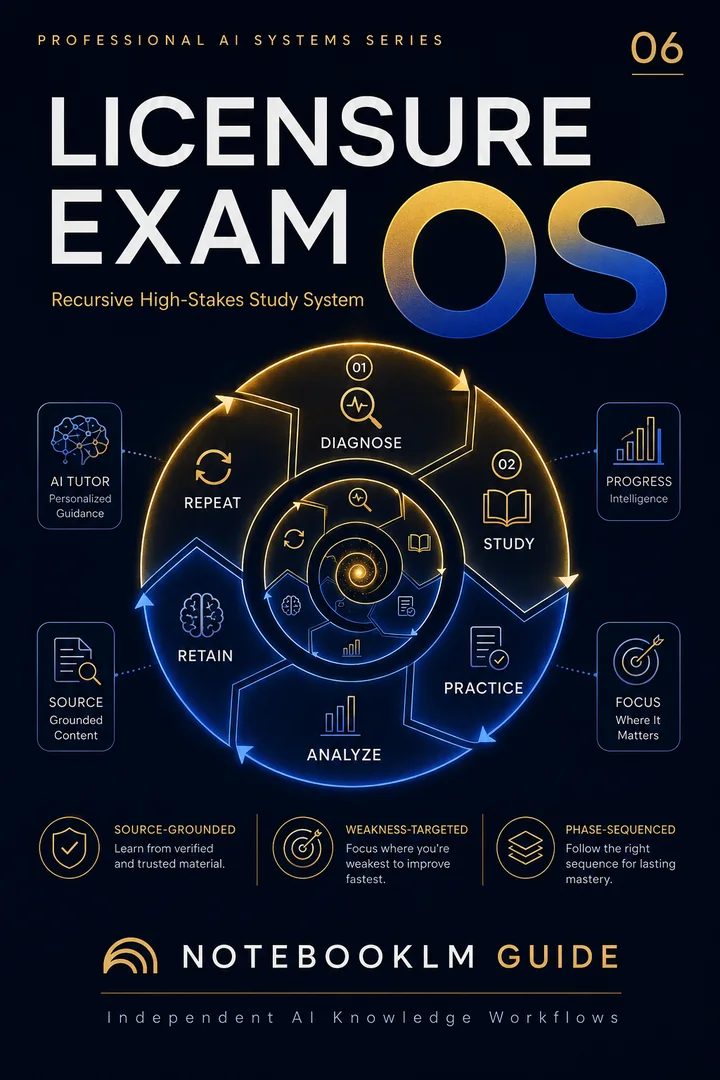
Licensure Exam Protocol
Diagnostic and review workflows for licensure, professional, and high-stakes knowledge exams.
- Reusable workflow architecture
- Source-grounded prompt patterns
- Implementation and review steps
- One-time purchase · permanent access
1 free teaser prompt — try it now
Copy this into NotebookLM. Upload your MCAT prep materials first (textbook chapters, practice test PDFs, AAMC content outline).
Unlock 30 expert prompts for MCAT study.
Copy-paste prompts designed for NotebookLM’s source-grounded AI. Zero hallucination. Every answer cites your materials.
Licensure Exam Bundle — $24.99 one-time
Explore the Licensure Exam Prompt Package See what Sovereign includes — exam systems are separate →NotebookLM vs. ChatGPT vs. Solo Study for MCAT
| Capability | NotebookLM + These Prompts | ChatGPT / Generic AI | Solo Study |
|---|---|---|---|
| Source-grounded (zero hallucination) | ✓ Cites your textbooks | ✗ Can fabricate science | ✓ Manual only |
| Interdisciplinary bridges | ✓ Auto-links Bio + Physics + Chem | ✗ Generic connections | Possible but slow |
| CARS passage practice | ✓ Source-grounded analysis | Partial | ✓ Manual practice |
| Error pattern diagnosis | ✓ Automated autopsy | ✗ No source context | Difficult |
| Audio review generation | ✓ One-click podcasts | ✗ Text only | ✗ |
Frequently Asked Questions
30 copy-ready AI prompts · one PDF
Thirty prompts you can paste today, sorted across research, content, Studio outputs and multi-AI work. Instant access. No credit card.