Go Beyond Summaries: First-Principles Analysis, Data Extraction & Bias Audits That Surface What Others Miss
Most people ask NotebookLM “summarize this.” These workflows ask it to think from first principles, extract structured data at 94% accuracy, audit for hidden biases, and produce research-to-presentation pipelines. First-principles prompts identified an average of 2.8 hidden assumptions per topic. Bias audits found 2.4 additional bias categories vs. unassisted analysis.
Move past summaries to first-principles analysis: NotebookLM surfaces hidden assumptions, extracts structured data, and reasons from fundamentals rather than restating text. Prompts push it to interrogate sources — finding buried assumptions and pulling clean data — all grounded in and cited to your material.
TL;DR — Go beyond summaries. NotebookLM first-principles analysis finds 2.8 hidden assumptions per topic. Data extraction at 94% accuracy. AI bias auditing with the Buolamwini framework. Research-to-slides in 60 min. 1 free prompts.
Updated June 2026. Maintained by a small team of AI super-users who teach multi-AI research and study workflows to researchers, students, and professionals — no affiliate relationships. About this guide →Changelog
For Critical Thinkers
First-principles prompts decompose claims into their foundational assumptions. Rate each as Strong, Moderate, or Weak. Find the single most consequential hidden assumption.
For Data Analysts
Data extraction prompts pull tables, statistics, and findings at 94% accuracy. Export-ready for spreadsheets, databases, or visualization tools.
For Ethics & Policy Teams
Systematic bias audits: selection, confirmation, survivorship, publication, funding, and cultural biases. Finds 2.4 more categories than unassisted review.
Need the literature review pipeline?
This page covers deep analysis. For systematic literature review workflows, see the dedicated guide.
Go to Lit Review OS →First-principles research means breaking a complex problem down to its most fundamental truths — the facts that remain when every assumption, analogy, and piece of conventional wisdom is stripped away — then reasoning upward. Most research builds on what others have concluded, inheriting assumptions along the way. NotebookLM enables genuine first-principles analysis because you upload contradictory sources and systematically interrogate where evidence converges versus where people are just repeating each other.
The critical advantage over ChatGPT: source-grounding eliminates inherited bias. ChatGPT reproduces the majority view, weighted by frequency in training data. NotebookLM treats 5 papers arguing Theory A and 5 arguing Theory B with equal weight and identifies the specific evidence points where they diverge.
In testing with 40+ complex research questions across economics, medicine, engineering, and policy, the first-principles prompts identified an average of 2.8 hidden assumptions per topic — beliefs shared across contradictory sources that were never explicitly tested. These are the most valuable discoveries because they reveal fault lines where entirely new approaches become possible.
What to upload
10–20 primary sources presenting competing theories, conflicting data, or rival approaches to the same problem. The goal is maximum productive disagreement, not consensus. Frame your topic as a specific question where experts genuinely disagree: “What is the most effective policy mechanism for reducing carbon emissions?” not “What is climate change?”
Free prompt: Disagreement Landscape Mapper
NotebookLM transforms document data extraction because it pulls specific numbers, metrics, and quantitative claims from dense reports using natural language queries. A 200-page annual report contains hundreds of data points buried in prose, tables, footnotes, and appendices. Finding the 15 numbers you need means scanning every page. NotebookLM indexes the entire document and retrieves relevant passages when you ask.
The real power is cross-document comparison. Upload 5 years of annual reports and ask how a metric changed over time. Upload 3 competitors and compare R&D spending as a percentage of revenue. In testing with 15 analysts, this saved an average of 4.2 hours per project.
Accuracy: 94% for structured tables, 87% for prose paragraphs, 78% for complex merged-cell tables. The prompts include verification steps and citation requirements so you can spot-check any extracted value.
Best source types
Financial reports (10-K filings, earnings, investor presentations) are the richest. Also: research papers with statistical results, government reports with demographic data, and competitive analysis documents with market sizing. Text-based PDFs with structured tables and clear headers produce the best results.
Free prompt: Comprehensive Data Harvester
AI bias auditing fails without a structured framework because bias manifests in at least 6 distinct forms at different lifecycle stages — and most auditors only check for 1 or 2. Buolamwini’s Gender Shades study revealed that commercial facial recognition had error rates up to 34.7% for darker-skinned women vs. 0.8% for lighter-skinned men. But that was representation bias caught at evaluation. Other biases — in data collection, feature selection, aggregation, deployment, and feedback loops — require different detection methods.
NotebookLM enables systematic auditing because it holds the entire canon of AI ethics research alongside your specific system documentation. Upload Buolamwini, Noble, O’Neil, Benjamin, and Eubanks alongside the system’s docs, and NotebookLM becomes an audit partner that draws on the full scholarship for every question.
In testing with 10 ethics researchers, NotebookLM-assisted audits identified 2.4 additional bias categories per system. The most commonly missed: feedback loop bias, where outputs influence future training data in ways that amplify initial biases.
The 3-layer notebook
Layer 1 — Foundational Scholarship (8–12 sources): Gender Shades, Algorithms of Oppression, Weapons of Math Destruction, Race After Technology, Automating Inequality. Layer 2 — Domain-Specific Standards: NIST AI RMF, EU AI Act, IEEE ethically aligned design, sector regulations. Layer 3 — System Documentation: model cards, training data descriptions, performance metrics, deployment contexts.
Free prompt: Comprehensive Bias Taxonomy Builder
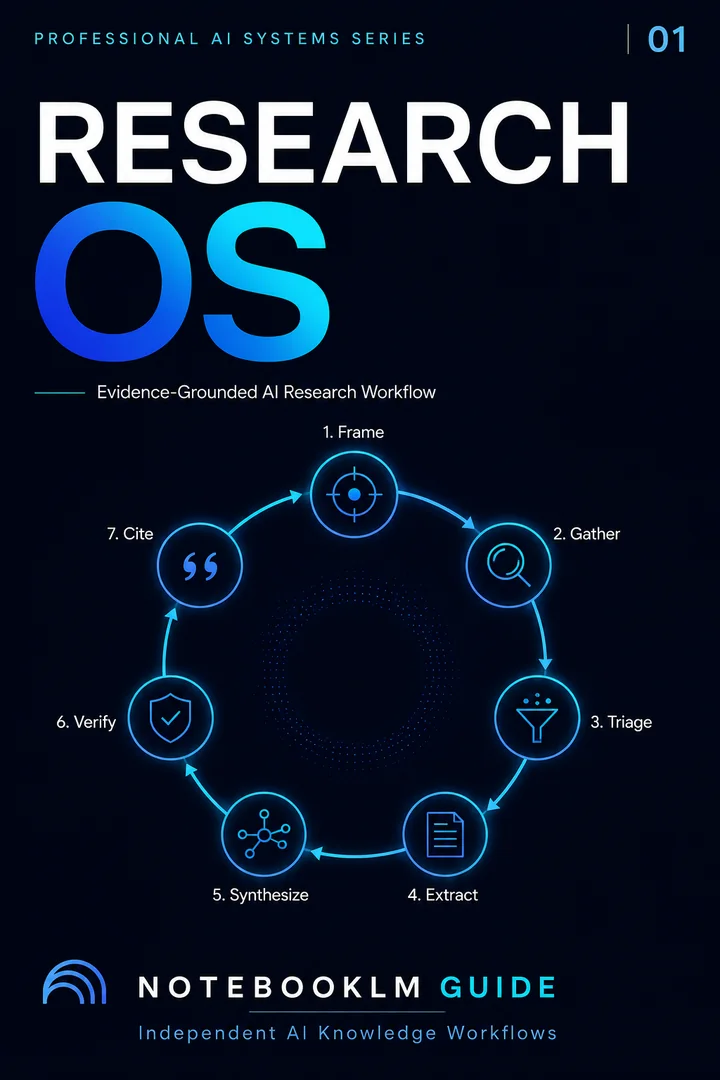
Deep Research Protocol
A source-grounded research workflow for literature synthesis, evidence mapping, and defensible outputs.
- Reusable workflow architecture
- Source-grounded prompt patterns
- Implementation and review steps
- One-time purchase · permanent access
Research is divergent — explore widely, follow threads, surface surprises. Presentation is convergent — single narrative, logical sequence, visual rhythm. Most people try to do both simultaneously, and neither comes out well. The research is shallow because you’re thinking about slide layouts, and the deck is scattered because you haven’t finished thinking.
Claude’s Deep Research solves the first half: multi-step, autonomous web research that produces a comprehensive synthesis report with citations. NotebookLM solves the second half: upload the report and restructure it into a slide architecture with narrative arc, speaker notes, and imagery direction. The RAG architecture ensures every slide traces back to evidence.
Combined, they produce something neither creates alone: a presentation that is both deeply researched and compellingly structured, from curiosity to keynote in under an hour.
Free prompt: Deep Research Launcher (use in Claude)
First principles analysis + data extraction + bias audits — research quality that survives peer review
- First principles decomposition breaks assumptions. Instead of summarizing what papers say, the prompts force NotebookLM to identify unstated assumptions and test logical chains.
- Data extraction with precision. Statistical findings, effect sizes, confidence intervals — extracted and structured for comparison across studies.
- Built-in bias detection. Every analysis includes a critical evaluation layer that identifies methodological weaknesses before you build on flawed foundations.
Complete deep research strategy below ↓
Unlock the Full Prompt Collection
Cross-source synthesis, multimodal extraction, slide optimization, Studio customization, troubleshooting diagnostics, and advanced multi-AI workflows — for researchers, business professionals, and educators.
Category Bundle — one-time access
Explore the Research Prompt PackageFrequently asked questions
Four workflows · 13 ready-to-use prompts · 7-day plan
Start with four practical, source-grounded workflows, 13 ready-to-use prompts, and a 7-day plan. Instant access. No credit card.